Showing posts with label trees. Show all posts

Thursday, February 13, 2014

wintertime loves


We in the arid parts of the West have been exulting in rain the last week or so. It's so comforting and even glorious to wake in the night and hear the rain still coming down. Then to wake in the morning and see it is still falling. We had puddles in the back yard! Thank you, Lord!

Mr. Glad and I do live in northern California, but daughter Pippin lives even farther north in the state, and we drove there early this week for a short visit. Often February is a very snowy month at her place, but this year they've had more dry weather and rain than snow, and even the rain stopped while we were there, so we could get outdoors easily for work and recreation.


One day we made a family project out of pruning old apple trees that Pippin and The Professor are trying to revive from years of neglect. I floated back and forth between lopping branches and swinging the kids.


I would get Scout and Ivy going and then run over to take a picture of the adults on ladders.


Another day we took a short trip to Castle Crags State Park and walked a trail alongside the Sacramento River. Considering the dryness of this year, I was amazed at the thick moss and ferns.


Port Orford Cedars like to grow next to rivers.
  
A pale green, almost white lichen grew on rocks and tree stumps.

yew trees on the riverbank
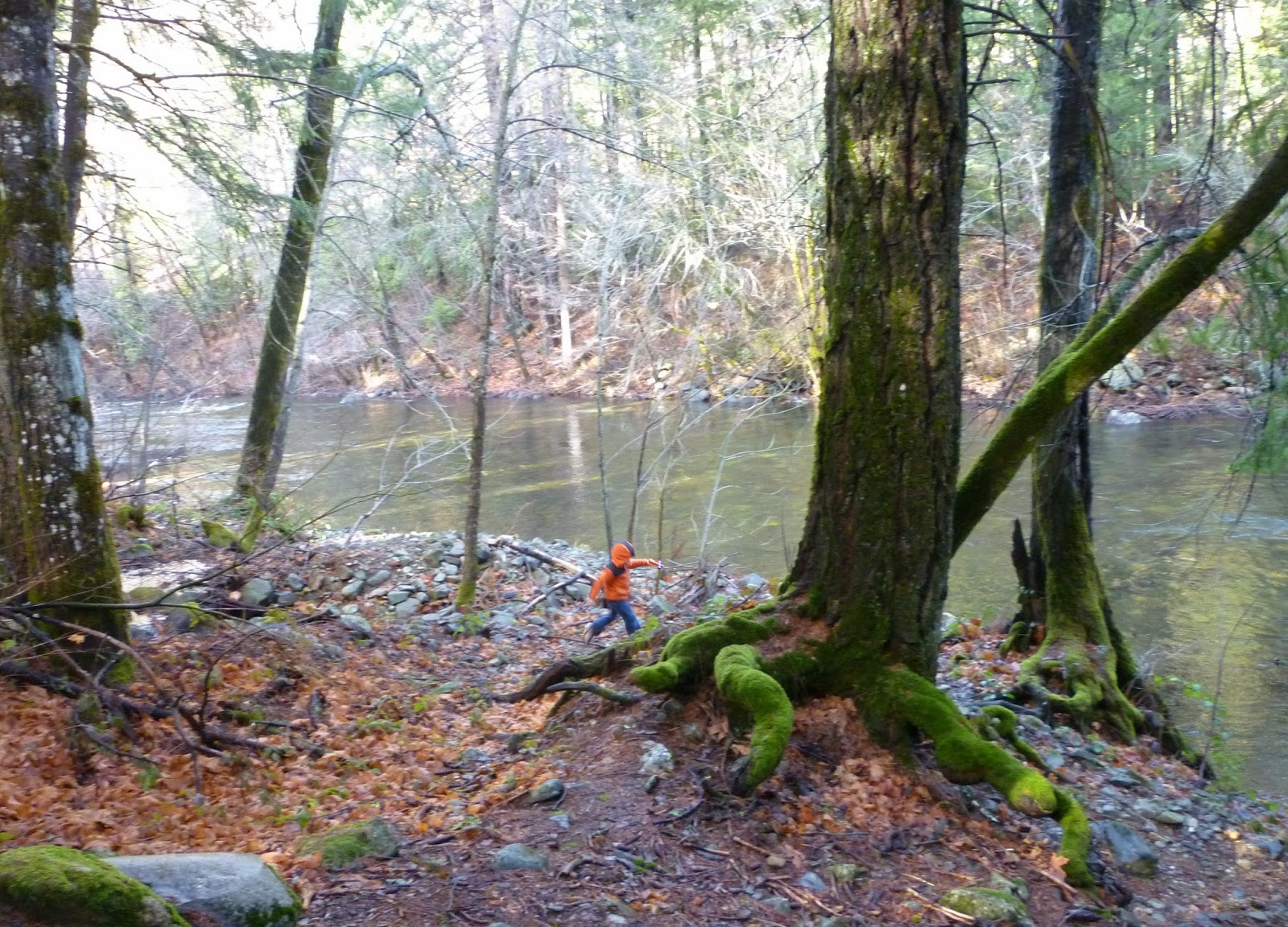
Grandson in orange jacket


Everything was wet from the recent rains, and many times our feet slipped on the invisible mosses -- or was it algae? -- growing on wooden bridges or river rocks.


Ivy practiced throwing pebbles into the river, and once she got the hang of it she did not want to do anything else. The supply of rocks was endless.

We went to the confluence of Castle Creek (in the foreground below) and the Sacramento River, from which you can get great views of the jagged rocks above, called the Castle Crags. They are high enough that the recent precipitation there was in the form of snow, and some was still unmelted and visible.


My dear husband showed me this large and artsy rock, which you can also see in the photo at the very top of this post, in its original setting. I wanted to take it home. It was a little too heavy for me to carry, so The Professor hauled it back to the car. It came with us on our journey home and is now living by our house. Mr. Glad classified it as a confluitic rock.

Winter days are short enough that at the end of our busy days there was plenty of time for cozy gatherings in the kitchen or by the wood stove. I read many books to the children. Scout's current favorite, which I read about on a blog before Christmas and gave to him, is Bumblebee at Apple Tree Lane, and we read it several times. Ivy likes The Little Fur Family best right now.

We danced to the children's favorite recordings, and also listened to bird calls on the Stokes Field Guide to Bird Songs CD. After ten minutes of loons and other waterfowl, Ivy must have deduced that those bird songs were some kind of dance music, too, and she started twisting and prancing around.

Hot soup is what you need on a winter's night, so Pippin and I learned how to make French Onion Soup, using the recipe in The New Best Recipe: All-New Edition by Cook's Illustrated Magazine. The secret that the Cook's testers learned is that red onions give the best flavor. Our result was sooo good.

And cookies! Pippin had some dough left in the freezer from her Christmas Peppernuts, the recipe that I concocted a long time ago but haven't made for years. We like our nuts to be nut-sized, so we always cut the frozen dough into little cubes and bake them long enough that they come out crispy. Next Christmas I'll give the recipe.

But for now, since I do love cookies, they make a good ending to my story 
of a wintry family visit that was warm and sweet.


Wednesday, February 5, 2014

How to become fresh and youthful.

The Paschal season of the Church is preceded by the season of Great Lent, which is also preceded by its own liturgical preparation. The first sign of the approach of Great Lent comes five Sundays before its beginning. On this Sunday the Gospel reading is about Zacchaeus the tax-collector. It tells how Christ brought salvation to the sinful man, and how his life was changed simply because he "sought to see who Jesus was" (Luke 19:3). The desire and effort to see Jesus begins the entire movement through Lent towards Pascha. It is the first movement of salvation.
This excerpt from our church bulletin explains why this date on the church calendar is a good one for someone to become a catechumen, as two people did on Sunday in my parish, and as I did seven years ago. It was not my first introduction to life in Christ, but it was definitely the time when I climbed up to the best vantage point to see Christ and His Church in all its fullness.

When I was a little child in Sunday School I learned some details of the story by way of a song:
Zacchaeus was a wee little man, a wee little man was he.
He climbed up in a sycamore tree for the Lord he wanted to see.
And when the Savior passed that way He looked up in the tree;
And He said, 'Zacchaeus, you come down, for I'm going to your house today.'
In his gospel homily Sunday our rector pointed out that the Lord also said, "Make haste." In other words, "Get down here, man! Don't be dilly-dallying about, but begin right now to mean business with God." And this week St. Nikolai explains how this man and his experience are meaningful to each of us:
"Today, salvation has come to this house" (St. Luke 19:9).

Thus it was spoken by the One Whose word is life and joy and restoration of the righteous. Just as the bleak forest clothes itself into greenery and flowers from the breath of spring, so does every man, regardless of how arid and darkened by sin, become fresh and youthful from the nearness of Christ. For the nearness of Christ is as the nearness of some life-giving and fragrant balsam which restores health, increases life, give fragrance to the soul, to the thoughts and to the words of man. In other words, distance from Christ means decay and death and His nearness means salvation and life.
....
Draw near to us O Lord, draw near and bring to us Your eternal salvation.

Tuesday, December 17, 2013

It cheers my heart like spirit'l wine.

I have just discovered the 18th-century hymn "Jesus Christ the Apple Tree," on this G.K. Chesterton site., where you can read good meditations on its meaning. It is thought to have been written by a New Englander, and has been set to various tunes. The most common seems to be the one by Elizabeth Poston, of which this video records a nice rendition.


The hymn has become associated with Christmas, and I'd like to add it to our own family's collection of carols, at least by next Christmas. "Under the shadow I will be, Of Jesus Christ the apple tree. "


Sunday, December 15, 2013

not a single place dark or unhappy

We have been ill around our house, and could not get going on the Christmas tree project until this week. Now we managed to get it up and decorated.

I cut off our homemade wood-shaving angel in the picture so I'm showing a close-up in the next. Mr. Glad did nearly all the tree-trimming this time, after he went all by himself to get the tree, a Noble Fir grown in Oregon.

Anna wrote last week about various Advent and Christmas trees she has known, and it made me want to remember some trees of the past. Her post includes a photograph of a large and dramatic Christmas tree in Norway.


I don't have anything that old, but at right is a picture of me in a red sweater in front of a 1950's tree. And at the bottom of the page, a little tree that the sister in the photograph gave me more recently. I like best to have birds and fruit and pine cones on my tree, and I never did like tinsel.

The boy at left (our Soldier, now grown) is posing by a tree from a minimalist era, when a friend let us cut from his property a wild and untamed specimen, on which we don't appear to have strung lights. But how strange and exciting for young children to have a tree in the house for a while, even undecorated.

Below, this year's tree before trimming, to go with a sweet poem e.e. cummings wrote.

little tree
little silent Christmas tree
you are so little
you are more like a flower

who found you in the green forest
and were you very sorry to come away?
see i will comfort you
because you smell so sweetly

i will kiss your cool bark
and hug you safe and tight
just as your mother would,
only don’t be afraid

look the spangles
that sleep all the year in a dark box
dreaming of being taken out and allowed to shine,
the balls the chains red and gold the fluffy threads,

put up your little arms
and i’ll give them all to you to hold
every finger shall have its ring
and there won’t be a single place dark or unhappy

then when you're quite dressed
you’ll stand in the window for everyone to see
and how they’ll stare!
oh but you’ll be very proud

and my little sister and i will take hands
and looking up at our beautiful tree
we’ll dance and sing
“Noel Noel”

Saturday, November 23, 2013

We shake the monastery olives.

The nuns at a nearby monastery needed some help with their yard work. We didn't know anything more specific, or that there would be some sadness involved, when Mr. Glad and I signed up to be on the crew for a Saturday work session. I had gardened here one spring day a couple of years ago and was looking forward to another chance to visit, this time doing fallish tasks.

What a bright and shining day it was, too, as we drove over the hill. Recent rains had washed all the earth and air, and high winds pretty much shook them out to dry. The humidity was only 10%.

When the head gardener Sister Xenia led our team of five to the clump of olive trees we saw that they were loaded with black fruit.

Then came the bad news: All of this harvest could not be used in any way, because it was infested with Mediterranean fruit flies. The trees needed to be stripped of olives, and the fruit that had fallen on the ground must be raked and swept up, and all of it taken to the dump.

In a month or two an arborist will prune the trees and some kind of spray will be used to inhibit the growth the the flies next spring. Whether there is hope of them being controlled in one year's time I don't know.

The olives were no good, not even the fat and shiny ones that were hanging on these lovely silvery trees with the light shimmering through.

So the men shook the trees and brought showers of fruit down on our heads. Mr. Glad climbed on the roof of a little house to reach higher branches of one tree, and then he climbed into the tree itself.

You can see olives on the ground in the shade.


Rosebushes that had grown leggy in the shade were snagging the guys when they were stretching up to shake and pick, so I ended up spending the first hour pruning the canes out of the way.


Bright orange fruit hung from the nearly bare branches of a Fuyu persimmon tree, the variety that is crunchy when ripe, and never puckery. At least this tree was healthy, and that was some consolation for the olive disaster.

We picked and pruned that tree, and Sister Xenia encouraged us to take some persimmons home, so I tucked a few into my gardening tote and am planning to use them like apples in baking.
Before we knew it, our work party was coming to an end, and we had been invited to eat the midday meal with the sisters.

Dining room all ready


But first there were prayers of the Sixth Hour, in the monastery chapel, and a few minutes of leisure for walking around the grounds.


I had been anticipating seeing the elegant koi again, and they did not disappoint. We found them gliding soundlessly in their long deep pond, swimming close for a few moments when I leaned over with my camera, until they sensed they weren't getting any food from us. A father and son were visiting them too, and happily chatting in Russian.


The monastery has a nice set of bells under a shake roof, with benches to sit on when the bells aren't being rung. They were used to announce the hour of prayer, but for the call to dinner Sister Marguerite walked all around the property shaking a little hand bell to ring a daintier and less commanding message.

The small amount of work we did seemed a puny offering considering all that we received by spending a few hours at the monastery. We were well fed with the most delicious fasting meal I've ever had, and we went home with armfuls of persimmons, having soaked up quite a lot of love and peace.

Of course I want to go back soon.


Thursday, November 21, 2013

delicious autumn recipe

The air was still cool, but the sun was already drawing the smells out of all the plants along the bike path when I walked along the creeks this morning. We had rain the last couple of days, so the leaves and grasses that have been drying to a crisp got washed and mixed into a good kind of stew.

My first impression, though, was auditory, the sound of ducks, and crows, and Canada geese, all commenting on the morning. Then a flash of silent white against the golden brown background, an egret, not squawking about anything, a quiet fisherman.


The paths are littered with piles of leaves, mostly brown now, like the live oak, which I was glad not to be sweeping off a patio. Their thorn-rimmed cups turn upside down and hold on to concrete surfaces for dear life. That last phrase will be my mnemonic from now on helping me to remember the name of at least one oak.

Mr. Glad wondered at my bringing home a redwood branch, when the tree behind us is dropping similar ones into our yard and pool every day and making hours of work for him to collect the prickly things. When you know you will have to retrieve each one from the bottom of the pool or the decking, it seems that the rich brown sprays are falling constantly, but the trees remain evergreen.

The little redwood cones is darling, isn't it? Less than an inch.

I leaned over a bridge and breathed in the essences of a thousand bits of living things, carried in the air still moist from the rains, and stirred together by the breeze. The dominant herb in the mix was the wild fennel, fallen down heavy with water, dried brown and mildewed black, and in a tumbled mess with blackberry brambles and grasses and everything I don't know the name of. The beauty that used to be visual is now distilled into heady scents.

It was reminiscent of an anisekuchen I have made at Christmastime, but the recipe for this nourishing treat includes a multitude of mysterious and essential ingredients. As I was whiffing my fill it seemed I would never want another bite of white-sugary anise cake or any kind of cake again -- can't I just run down to this creek bed and breathe? Oh, but it's a seasonal dish, and you never know just how long it will be served. But come back tomorrow and something nice will be on the menu for sure!

Asian pear

Wednesday, October 30, 2013

How long will the rocks of Berkeley last?

Berkeley Camellia in October
My sisters came to visit, and for the first time in about 50 years we returned together to places in Berkeley where we used to play. None of us has ever lived there, but as children we visited our maternal grandparents every summer.

Both of our parents had grown up in Berkeley, and last week we walked and drove the mostly hilly streets to find several of the houses in which our grandparents and our father and his sisters had lived. Of course we also stopped and stared at our other grandma's house, savoring the memories that had been born in us there.

Not far away is Indian Rock Park, of which you can see pictures in my post about the neighborhood where Grandma and Grandpa lived for half a century. Indian Rock is huge -- but not as big as we remembered it. And the park includes massive slabs and lava stones directly across the street, which I don't know if I've ever played on. We didn't go there this time, either, but climbed to the top of Indian Rock itself and sat a while, looking out over the tops of a thousand houses to San Francisco Bay.


Down Indian Rock Path


Not for very long, though, because we wanted to skip on down the steps of Indian Rock Path to Solano Avenue shops. Well, maybe not skip. But skipping is probably what we used to do!


Jade plant in bloom on the path

In our memories the excursion to the ice cream parlor took much longer than what we found this time, even though we have passed the age when one can be unconscious of one's legs and feet whether walking uphill or down. That shop has a new name, but the wares are similar, and you can look at old scoops while you wait.

After lunch, because we wanted to return to the higher neighborhood, it was necessary to hike up, and this time we took the steep route of Marin Avenue. Again my experience seemed altogether different from that of years ago, when most evenings after dinner Grandma, at an age greater than any of us have reached yet, would lead us on brisk neighborhood walks. It was slower than then. And the crucial person was missing.
Marin Avenue is a hike.

Mortar Rock steps
We circled back to Mortar Rock, just around the corner from Indian Rock, and wandered there longer, just as we used to play there longer in our childhoods. More of those stone surfaces are easily climbable, and Grandma always felt better about us going by ourselves, because we didn't have to cross a busy street to get there.

The houses next to these parks and paths don't have much privacy. In this picture you can see how close they are, and how there are not fences blocking them from park goers and their glances.


When I first put my feet on the dry paths of Mortar Rock Park, suddenly a familar herby smell registered in my senses, making me look down to see long pointy dead leaves underfoot, just as my mind was linking to "bay tree." I lifted my head and saw that the dappled shade was cast by at least two tall old California Bay Laurels (along with oaks and buckeye) whose several large trunks were curving high over the rocks.

And yes, there were the grinding mortars in the rock, empty of anything but leaves at this time of year. Do children still pretend to be Indians grinding acorns in them?


One of the houses we were searching for was only a few blocks from here, so we walked up the street, admiring the many flowers still in bloom in this mild climate. Banks of fuchsias always remind us of the long row of them that grew along the brick path in Grandma and Grandpa's back yard.
More rocks! This house, though modern in design, has a very traditional and unchanging boulder to distinguish its front yard.


This one's even more of a monolith. Having such a thing in your front yard would certainly lend drama to the landscaping. I wonder if the owners of the house are helped to keep a humble perspective on their lives, with the antiquity of their mineral friend constantly looming. So solid, and not going anywhere. 


Lots of giant volcanic rocks dot the neighborhood. I saw these I didn't remember on Santa Barbara Avenue, taking up a lot or two.
Rocks on Santa Barbara Ave., Berkeley CA
The weather was summery, and we seemed to walk always up, and up. It felt good to stop frequently to snap pictures of fall color or late summer flowers. Eventually we arrived at the first house of our father's on our list, on Santa Barbara Avenue.

Another childhood home of my father, on Euclid, has had a facelift recently -- we compared it with photos from 15 years ago when a patriarchal tree must have blocked the view and the warming sunlight, and the color was white. Paint and trees and even whole houses are easier to change or remove than those giant rocks.
Euclid house
And though it seems ages ago that we walked these streets together, and slept in the Berkeley bedroom wondering at the city lights spread out before us, most of these houses are not more than a hundred years old. Young things, really.

We went back to our car and drove to a few more houses, none so photogenic now. We bought gas at the station where our grandma used to buy hers, and we shopped at the market where she used to shop. We ate dinner at Spenger's Fish Grotto where we'd eaten many times with our grandparents. And then my dear sisters and I finished our day with shopping at our grandma's favorite Park & Shop market, now Andronico's.

But a little earlier in the evening we'd added to our tour a visit to the cemetery where both Grandma and Grandpa are buried. None of us had visited since the last graveside service almost 20 years ago, and it took some exploring to find the marker. I felt closer to Grandma and Grandpa there at their grave than I had on the street in front of their house.

Cemeteries are where one finds another sort of stone, markers of lives that grew up like grass, and withered and died, most with life spans briefer even than flimsy wooden houses and certainly shorter than those huge stones people built neighborhoods around fairly recently. At the end of time, we read in 2 Peter, "... the day of the Lord will come as a thief in the night; in the which the heavens shall pass away with a great noise, and the elements shall melt with fervent heat, the earth also and the works that are therein shall be burned up."

Indian Rock and all the granite in the Sierras, though it's been around longer than we can imagine, will be gone, along with houses and gravestones. Then what is most enduring, the souls into whom God breathed life, will be raised. We are what on this earth is eternal.