Showing posts with label books. Show all posts

Monday, March 17, 2014

The Tide in the River

A short verse stuck in my mind over 20 years ago, and has been playing there off and on out of a proper context. I'm pretty sure it came to me in a book of poems for children, and somewhere along the way I incorrectly connected it with Longfellow; when recently I searched around online for a while I found that the author is Eleanor Farjeon.

Only once that I can remember did the meaning fit with the situation, when I was with my dear husband on a short getaway to celebrate our wedding anniversary. We were staying in the company town of Scotia in way-northern California, where the sawmill is built near the Eel River.

After dinner we walked in the dark around the village of Rio Dell close by, and on our way back to the hotel stopped on the bridge to lean over the rail; we listened to the quiet flowing noise and could barely make out the stream down below. Here was the right time and place, and the verse very nimbly popped into my mind, and I recited:
The tide in the river,
The tide in the river runs deep.
I saw a shiver
Pass over the river
As the tide turned in its sleep.
         --Eleanor Farejon
Now we're celebrating that blessed day once more, but we're driving to California's Central Coast this time for our little vacation, to the town of Cambria where we spent part of our honeymoon and which we haven't visited since. Maybe we'll go to the beach this time. Let me see, do I know any beach-y verse I could get ready?

Saturday, March 15, 2014

defeat of the bogey


Fairy tales do not give the child his first idea of bogey. What fairy tales give the child is his first clear idea of the possible defeat of bogey. The baby has known the dragon intimately ever since he had an imagination. What the fairy tale provides for him is a St. George to kill the dragon.
      ― G.K. Chesterton, Tremendous Trifles
 Linking up to Weekends With Chesterton

Monday, March 10, 2014

On the ground with the White Horse.


Last week The Garners posted about G.K. Chesterton's Ballad of the White Horse, which caused me to dig out my cassette tapes of the author reading his own poem -- how thrilling! Too bad they were made from a scratchy recording so that it's very hard to appreciate the poem itself. Still, the directness of the connection to the very voice and person of the poet mean a lot to me.

What made me interested in the Ballad in the first place was taking a trip to Britain with daughter Pippin nine years ago. We both very much wanted to see White Horse Hill in Uffington while we were there, and we found it quite empty of any other humans the day we visited. We hiked up the hill to the chalk art that is thought to be 2,000 to 3,000 years old, and wandered around the horse's anatomy. We couldn't pull ourselves away. I just could not get over -- here it is again -- the earthy material link to ancient peoples and the mysteries of their culture and history.

One thing we share with the ancient people who carved the trenches of this design is human nature, the gifts of the Creator who made us in His image, glorious even in a tarnished condition. The horse reveals the creative aspect of that image, and Chesterton's ballad shows his own artistry while it tells a human and Christian tale set in King Alfred's day. The imagery in this stanza, which I think pertinent to the Lenten season, illuminates another aspect of our humanity that we share with our ancestors: the impulse to stand before God in worship, fighting with the desire to be God:
Pride juggles with her toppling towers,

They strike the sun and cease,

But the firm feet of humility

They grip the ground like trees.  

                       -G.K. Chesterton, The Ballad of the White Horse
Thinking again about this world history and my history, I want to revisit the horse vicariously, by means of the poem slightly more removed from the poet than my old cassettes. So I just ordered this edition of the book, which I think is the one I bought two copies of in the past for gifts. The American Chesterton Society will be sending me this CD, read by Aidan Mackey, who sounds as though he is very likely, once I put that disk in the player, to send me right back to England and White Horse Hill.

Linking up to Weekends With Chesterton

Friday, February 28, 2014

RFC drinks in graces.

It was St. Thomas, I think, who pointed out a long time ago that if God wanted to get rid of the universe, He would not have to do anything; He would have to stop doing something. Wine is -- the fruit of the vine stands in act, outside of nothing -- because it is His very present pleasure to have it so. The creative act is contemporary, intimate, and immediate to each part, parcel and period of the world.
     ...The bloom of yeast lies upon the grapeskins year after year because He likes it; C6H12O6=2C2H5OH+CO2 is a dependable process because, every September, He says, That was nice; do it again.
     Let us pause and drink to that.
Robert Farrar Capon knows well that there are people who will not drink to anything, because they are teetotalers. He's writing this chapter on "Water in Excelsis," in the book The Supper of the Lamb, about a God Who delights in his creation, and he is not sympathetic to what he sees as a mistaken attitude: "Only the ungrateful or the purblind can fail to see that sugar in the grape and yeast on the skins is a divine idea, not a human one."

And as for what he calls The Woman's Christian Temperance Union's version of The Lord's Supper, only about 100 years old and lacking completely what Holy Scripture and church tradition prescribe as the proper drink, he does not shrink back from engaging its adherents in argument, particularly the ones who think that the Greek word for wine in the Gospels meant something other than wine.
The commentator cited, as I recall, grape juice for one meaning, and raisin paste for another. He inclined, ultimately, toward the latter.
     I suppose such people are blessed with reverent minds which prevent them from drawing irreverent conclusions. I myself, however, could never resist the temptation to read raisin paste for wine in the story of the Miracle of Cana. "When the ruler of the feast had tasted the water that was made raisin paste...he said unto the bridegroom, 'Every man at the beginning doth set forth good raisin paste, and when men have well drunk [eaten? -- the text is no doubt corrupt], then that which is worse: but thou hast kept the good raisin paste until now.'" Does it not whet your appetite for the critical opera omnia of such an author, where he will freely have at the length and breadth of Scripture? Can you not see his promised land flowing with peanut butter and jelly; his apocalypse, in which the great whore Babylon is given the cup of the ginger ale of the fierceness of the wrath of God?
Capon has a different argument with secularists, and it is over their classifying wine as an alcoholic beverage, when the author knows it as a class in itself, far removed from the hard liquor that is often used to ill effect, and which he tells us is "for strong souls after great dinners." Capon:
With wine at hand, the good man concerns himself, not with getting drunk, but with drinking in all the natural delectabilities of wine: taste, color, bouquet; its manifold graces; the way it complements food and enhances conversation; and its sovereign power to turn evenings into occasions, to lift eating beyond nourishment to conviviality, and to bring the race, for a few hours at least, to that happy state where men are wise and women beautiful, and even one's children begin to look promising.
I admit I am inspired by RFC's eager receptivity to God's gifts. What little appreciation I've had for wine as a beverage has been slow in developing, and I let my husband be in charge of that aspect of our dining. But wine in the chalice of Holy Communion has always seemed to me the obvious choice in obedience to Christ's teaching.

This chapter contains more and expanded theologizing about the secular and the sacred, using wine and the making of wine as a demonstration of the goodness and delight of God. I am still musing on much of this and hope to ramble on here again, sharing with you the infectious loves of Robert Farrar Capon.

Other posts in this series are:
RFC is the man we need.
RFC begins with the meat.
RFC considers blood and sacrifice.
RFC makes one of nature's marvels.
RFC for Butter Week

Tuesday, February 25, 2014

Kinds of Poetry - Tolkien vs. Jackson

Jackson apparently thinks the characters Tolkien gives us are too simply good to be fully believable to modern audiences, and so he feels obligated to "complicate" them, to give them internal conflicts other than the ones they actually have, in the hopes that we will better be able to relate to them.
I'm quoting from this article in the Nov/Dec 2013 Touchstone Magazine, in which Donald T. Williams explains how literature, while delighting us with its art, is more powerful than history or philosophy to nurture our moral vision, or to corrupt us with false images.

With the help of quotes from Sir Philip Sidney, who wrote Apology for Poetry in the sixteenth century, he shows how "Tolkien was very consciously and deliberately following the literary tradition that flows down to us from Sidney through Dr. Johnson and C. S. Lewis."

Peter Jackson the filmmaker seems to be flowing in a different stream. But he is an artist, and of course will impart his own soul to his work. I wouldn't expect him to give us The Rings, because that has already been done, and he is not J.R.R. Tolkien. But it is unfortunate that he has changed things to the degree and in the directions he has. Williams points out specific ways in which the characters who inspired us in the books disappoint us in the movies, and makes these general remarks:
By this process of negative moral transformation, in other words, we reach the place where beloved characters are unrecognizable to Tolkien's fans, and those fans feel betrayed. And they are right to feel so, though mostly they do not understand why. It is because the difference between the books and the movies is not just one of necessary adaptation to a different medium. It is that the author consciously followed the Sidneyan tradition while the adaptor is either ignorant of it or doesn't understand it or has rejected it.
Read the whole article here.

Monday, February 24, 2014

RFC for Butter Week

Please don't try Roger Farrar Capon's baklava recipe. He describes it as "french-fried," and yes, it does involved a large quantity of oil ! which I declare a horrid perversion of the spirit of baklava. This is the first thing I have found in The Supper of the Lamb that has so disappointed and surprised me. I guess no one can be perfect.

But the perfect baklava recipe does exist, simplicity itself for method; and for taste, the divine melding of flavors, of which that of Butter is central. It is the one used in my parish to make umpteen sheet pans of baklava every year for festivals and celebratory meals, and I will eventually make it at home and share the recipe here.


As I write, we Orthodox Christians are in the midst of what is sometimes called Butter Week, the week before Lent properly begins, and the last in which we eat dairy products (but start fasting from meat). The perfect time to tell about Capon's attitude toward butter, which I am very sympathetic to. For example, at the end of a section on sauces he shares:
One last secret. There is almost no sauce that will not be improved by having a lump of butter whisked into it the moment before it is served. In addition to what it does for the flavor, it provides the sauce itself with a patina, a sheen which delights the eye even before the palate begins to judge. It is an embellishment not lightly to be forgone. Dishes should come to the table vested, robed. Don Giovanni is marvelous any way you can get to hear it. But given a choice between seeing it performed full dress, or on a bare stage with the cast in T shirts and sneakers, no rational man would hesitate. A great sauce deserves a great finish. Whatever you do, therefore, don't omit the final grace -- the loving pat of butter.
Those last words remind me of my grandmother, who showed this kind of love in her kitchen and to those she fed, including herself, and she lived healthily and on her own past the age of 100. I can still picture her standing by the stove and tucking fat pats of butter into the slits she had made in our baked potatoes just before taking them to the dining table.

Capon considers bread and butter, or cheese, to be basic ferial (everyday) food for those meals that one is keeping simple and light, for the sake of being able to enjoy real feasting less often. I'll write more on that principle later. In contrast to bread and butter, we have what RFC calls "the epitome of baking": pastry. He gives a lot of time and great detail to teaching us how to make puff pastry and Danish pastry, which must be made with butter, of course. I personally am not interested in this kind of cooking at my stage of life, and am happy to eat my butter in a hundred places other than pastry. Capon explains further that butter
...is not, in any except the merely technical sense of the word, grease. It melts at the temperature of the tongue, and consequently goes down as easily as cream. (You do not like to drink cream? I am sorry. Let us agree to disagree and get on with it.) Any man who cannot tell the difference between butter and margarine has callouses on the inside of his mouth...Butter is a substance in its own right, justified by its own delectability, not by its contributory services. It is a unique and solid sauce; it is apt to more dishes than anything in the world, and it is, like all the greatest sauces, worthy of being eaten plain.
Besides pastry, there are many recipes at the back of the book that feature this blessed food, including what look to be very nice cakes and cookies. I think all of us have plenty of that kind of recipe already, and if you don't, just look on my own Recipes and Vague Instructions page on this blog. I wholeheartedly agree with RFC that butter "glorifies almost everything it touches."


Other posts in this series are:
RFC is the man we need.
RFC begins with the meat.
RFC considers blood and sacrifice.
RFC makes one of nature's marvels.

Saturday, February 22, 2014

Let them believe.


It is assumed that the skeptic has no bias;
whereas he has an obvious bias in favor of skepticism.

That is the one eternal education:
to be sure enough that something is true
that you dare to tell it to a child.

-- G.K. Chesterton

These quotes having to do with teaching and learning remind me of something I read years ago when we were in the middle of our 21 years of homeschooling. It was in John Senior's book The Restoration of Christian Culture, which I had borrowed and still don't own, so it may be that I am not remembering it exactly right. I'd love it if any of you know enough to correct me or just articulate more clearly what I am trying to get at.

Dr. Senior warned parents against teaching children what modern educators call "critical thinking," because it would turn them into skeptics and take away the simplicity of their childhood. They need to be taught to believe, rather than to doubt, and to have their joy and love for the world nurtured. If we teach them to be skeptics we are guilty of stunting their souls.

I thought about these things when I read an article by Ken Myers that was published last summer in Touchstone, titled "Trinity & Modernity" (unfortunately not available online). In it he introduces us to the book The One, the Three and the Many: God, Creation and the Culture of Modernity by Colin Gunton, and Myers discusses the fragmentation of current culture and thought, and the necessity of Trinitarian faith and the Body of Christ if we are to be saved from "modernity's fatal confusion."

His introductory paragraphs are what I want to share here, about our universal Christian story.
We have been told that to be postmodern is to approach metanarratives -- the Big Stories that explain Life, the Universe, and Everything -- with incredulity. Of course, this raises the question of whether or not this definition of the postmodern temperament is itself a metanarrative...

...I do detect among most younger people a yawning indifference to efforts to explain history or theology or ethics or art in terms of grand and arching chronologies or chronicles. I suspect their minds and hearts have been colonized by thousands of what [Jean-François] Lyotard called petit récits, small amounts of highly particular and often idiosyncratic episodes, all blithely disconnected from any framework, all resistant to organization in any structure of meaning. Perpetual exposure to a numbing torrent of bewildering bursts of narrativish fragments -- increasingly in fewer than 140 characters -- leaves little time or mental space for attending to connections and causality.

I remain unrepentantly pre-modern in my love of metanarratives. If the gospel has any power, it is only because it tells a great story that explains all things. It is a very particular story and it makes universal claims, which make both card-carrying moderns and postmoderns nervous. It was foolishness to the Greeks as well.
This fragmentation and lack of understanding was a problem even in Chesterton's day, but certainly it's worse in more recent decades, with the giving over of education to a woefully pragmatic vision (Perhaps we do have a metanarrative: Do Whatever You Have To, To Get a Good Job.) and the gazillion bits of information and "communication" of the computer age.

I always had Truth to tell to my children, because I knew at heart that Christ was the "yea and amen to all the promises of God," and God was the Creator and upholder of everything. But in my experience the Protestant Evangelical world lacked cohesion, and certainly the continuity with the history faith that would make it a true metanarrative.

It was incomplete, fragments that could not explain Everything, and I am sorry that I couldn't tell my young children the Big Story that I am learning now, now that I am coming to know Christ and His Church. In The Church we have Christ the Head of the body. They go together, and can't really convey the faith any other way. Christ comes to us in His Church, "the fullness of Him that filleth all in all."

The intellectual focus of the West -- which even we in the Eastern Orthodox Church breathe in the air of the modern world -- seems to make it hard for me to avoid skepticism in myself. I can't see that anything but prayer and sacrament can keep my heart tender and trusting. Let's pray for the children, too, that they might be saved from the spirit of the age.

Linking up to Weekends with Chesterton

Wednesday, February 19, 2014

RFC makes one of nature's marvels.

In the chapter titled "Living Water" in The Supper of the Lamb, in which we learn how to make Brown Stock and White Stock, Robert Farrar Capon continues, "...you are now ready for the really astonishing part of the exercise." It's the lead-in to another of the recipes that are scattered throughout the first two-thirds of The Supper of the Lamb, with more of them concentrated in the recipe section at the back.

Many of the recipes seem a little outdated now, but I doubt I'd have taken to the foods featured in Supper even in 1969 when it was first published, because I was just learning to live on my own and to eat rice and vegetables. Our ferial eating in those days was sparser of meat and wine than RFC could have imagined, and Diet for a Small Planet was the go-to cookbook. It would be another ten or fifteen years before I bought my first leg of lamb.

Nowadays I am well supplied with recipes for most everything I could possibly want to cook, but Capon's next suggestion sounds so strange and appealing that I think I will have to try it eventually. If I had to choose between meat and butter, two foods at the top of my list of culinary loves, I guess I'm just sensible enough to choose meat, and when RFC tells me I can capture its "heart and soul" in my kitchen, I can't resist his encouragement to create something of which he also claims, "...you will find yourself whittling off little pieces to dissolve on your tongue at odd times of the day."

I'll just give you the whole recipe here, because though we no doubt can find a version online, I naturally like the style of this one. It will be my last "meaty" post on this book, because in my church we are beginning our Lenten fast from meat very soon, and it's time for me to turn the page.
HOMEMADE MEAT GLAZE
(Meat Extract)

Take the strainerful of bones and scraps [from which you have made the stock] and put them back into the stockpot. Add any scraps of meat you have around: poultry, pork, veal -- even leftover hamburger -- just stay away from lamb and ham. Meat extract can, of course, be made from the used bones alone, but anything that brings more natural gelatin to the pot is welcome. Cover everything deeply with cold water, adding no salt at all, and boil for two or three hours more.

That done, strain once again, this time into a large saucepan. Discard the bones. (They have been worked to death. Even the dog will look down his nose at them now.)

Boil the contents of the pan hard, skimming the froth from the top now and then, until the liquid is drastically reduced. When it is down to about a pint, transfer it to a smaller pan and boil on, over slightly reduced heat. Continue boiling until it reaches the consistency of a thick, blackish-brown syrup (half a cup, give or take a little). Pour this into a heatproof jar, cool, and refrigerate.

You now have, perhaps for the first time in your life, real meat extract -- one of nature's marvels. It is, of course, highly concentrated gelatin, but it has been imbued with the heart and soul of meat. Its taste is beautiful. Moreover, in spite of the fact that no speck of salt went into all those quarts of water the second time around, it is salted to perfection. Its consistency is, admittedly, a little forbidding; It is not unlike a young and tender shoe heel. Refrigerated, it will keep in this state for weeks; but, obligingly enough, it melts at the temperature of the mouth. If you are any lover of food at all, you will find yourself whittling off little pieces to dissolve on your tongue at odd times of the day.

Use it ad lib. Its general effect is to give a sauce soul and substance without overpowering the proper flavor of the dish. Experiment. It improves almost anything. A tablespoonful melted in warm Hollandaise imparts a certain roundness and resonance to what is sometimes an excessively light and lemony sauce. A piece dropped on top of a hot fried egg (plus a dash of Tabasco, if you are up to it) is delightful. And in the form of Colbert Butter, it is the perfect accompaniment to steaks, chops, fish, or poultry -- not to mention a piece of matzoh at three in the afternoon.

Sunday, February 16, 2014

RFC considers blood and sacrifice.

I owe you something more, however -- something darker -- on the subject of meat: The minor leads inexorably to the monumental. Lamb has set our feet in a large room indeed. Man not only dines: he also kills and sacrifices. The room in which he relishes the animal orders lies between slaughterhouse and temple. There are death's heads at each end of the table of the world.
In The Supper of the Lamb: A Culinary Reflection Robert Farrar Capon introduces what is perhaps the most poetic chapter with this paragraph. He explores our human proclivity to hunting and butchering and the Jewish temple sacrifices in a long poem that I mostly didn't have the patience for, though I liked its division into sections named for the categories of the car game:
Animal, Vegetable, Mineral;
Testing the textures of creation,
     savoring the styles of its coinherence.
After describing the neat and clean Mineral parts of our world, he moves on to the Vegetable, "the kingdom of seed, birth, life....And for the first time,/ the reek of death." But

Onions die quietly,
Cabbages shed no blood;
All plants forgive:
By the waters that comprise them
They wash man's hands
And let him walk away.
Eating vegetables is so innocent. But Capon doesn't want to ignore the reality of our place as carnivores, so he unapologetically moves on to the Animal kingdom
each man owning the honest interchange by which he steals his livelihood; each woman's hand intimate with the crack of wrung neck and severed spine....
It is not possible or even desirable to distill the writer's poem into a fully satisfying theology, but I wanted my readers to know that he does satisfy himself with the mysteries of God's plan of salvation, of which the temple sacrifices were a foreshadowing of Christ's sacrifice on the cross.
The world awaits
The unimaginable union
By which the Lion lifts Himself Lamb slain
And, Priest and Victim,
Brings
The City
Home.


Other posts in this series are:
RFC is the man we need.
RFC begins with the meat.

Thursday, February 13, 2014

wintertime loves


We in the arid parts of the West have been exulting in rain the last week or so. It's so comforting and even glorious to wake in the night and hear the rain still coming down. Then to wake in the morning and see it is still falling. We had puddles in the back yard! Thank you, Lord!

Mr. Glad and I do live in northern California, but daughter Pippin lives even farther north in the state, and we drove there early this week for a short visit. Often February is a very snowy month at her place, but this year they've had more dry weather and rain than snow, and even the rain stopped while we were there, so we could get outdoors easily for work and recreation.


One day we made a family project out of pruning old apple trees that Pippin and The Professor are trying to revive from years of neglect. I floated back and forth between lopping branches and swinging the kids.


I would get Scout and Ivy going and then run over to take a picture of the adults on ladders.


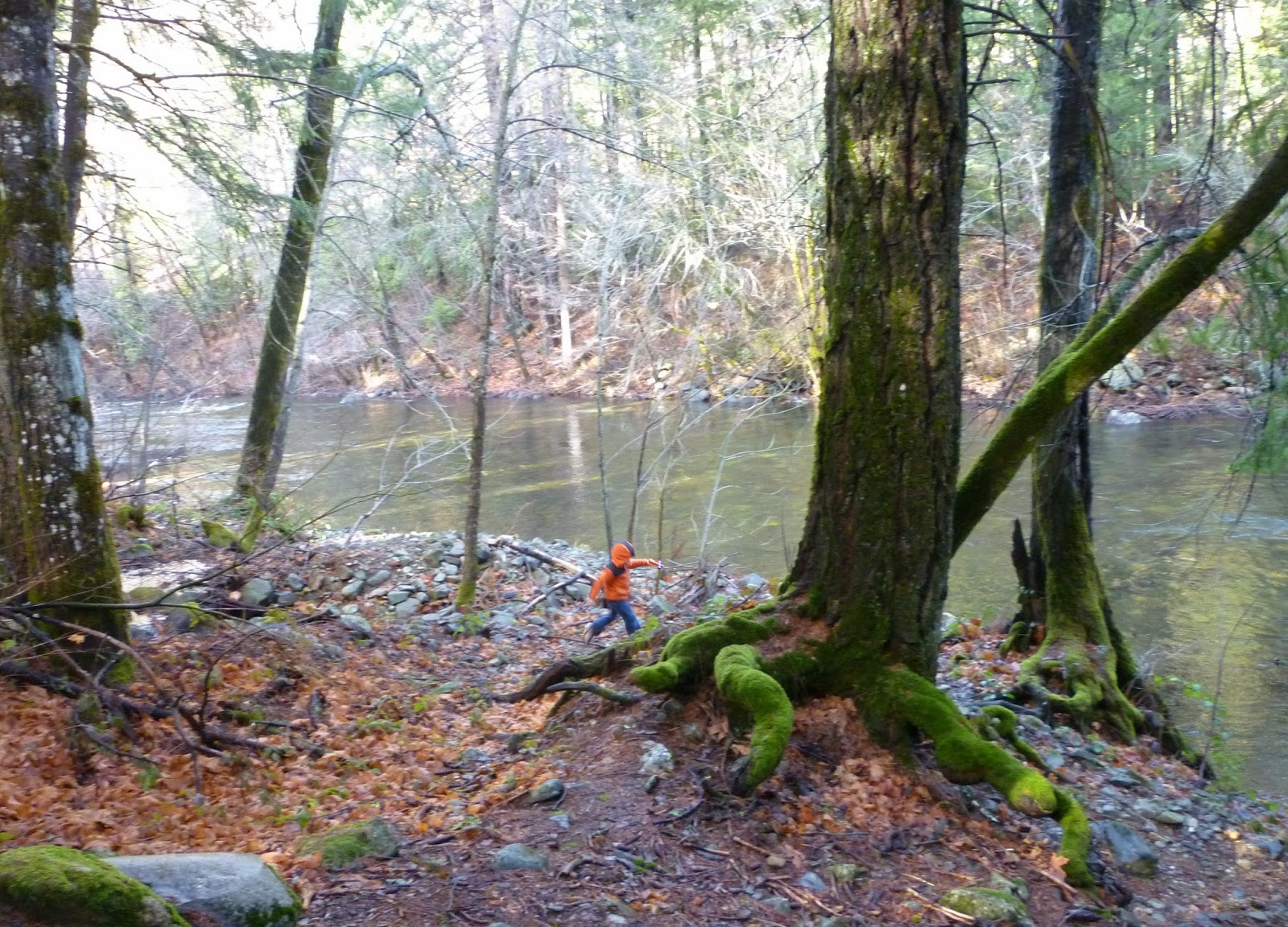
Another day we took a short trip to Castle Crags State Park and walked a trail alongside the Sacramento River. Considering the dryness of this year, I was amazed at the thick moss and ferns.


Port Orford Cedars like to grow next to rivers.
  
A pale green, almost white lichen grew on rocks and tree stumps.

yew trees on the riverbank
Grandson in orange jacket


Everything was wet from the recent rains, and many times our feet slipped on the invisible mosses -- or was it algae? -- growing on wooden bridges or river rocks.


Ivy practiced throwing pebbles into the river, and once she got the hang of it she did not want to do anything else. The supply of rocks was endless.

We went to the confluence of Castle Creek (in the foreground below) and the Sacramento River, from which you can get great views of the jagged rocks above, called the Castle Crags. They are high enough that the recent precipitation there was in the form of snow, and some was still unmelted and visible.


My dear husband showed me this large and artsy rock, which you can also see in the photo at the very top of this post, in its original setting. I wanted to take it home. It was a little too heavy for me to carry, so The Professor hauled it back to the car. It came with us on our journey home and is now living by our house. Mr. Glad classified it as a confluitic rock.

Winter days are short enough that at the end of our busy days there was plenty of time for cozy gatherings in the kitchen or by the wood stove. I read many books to the children. Scout's current favorite, which I read about on a blog before Christmas and gave to him, is Bumblebee at Apple Tree Lane, and we read it several times. Ivy likes The Little Fur Family best right now.

We danced to the children's favorite recordings, and also listened to bird calls on the Stokes Field Guide to Bird Songs CD. After ten minutes of loons and other waterfowl, Ivy must have deduced that those bird songs were some kind of dance music, too, and she started twisting and prancing around.

Hot soup is what you need on a winter's night, so Pippin and I learned how to make French Onion Soup, using the recipe in The New Best Recipe: All-New Edition by Cook's Illustrated Magazine. The secret that the Cook's testers learned is that red onions give the best flavor. Our result was sooo good.

And cookies! Pippin had some dough left in the freezer from her Christmas Peppernuts, the recipe that I concocted a long time ago but haven't made for years. We like our nuts to be nut-sized, so we always cut the frozen dough into little cubes and bake them long enough that they come out crispy. Next Christmas I'll give the recipe.

But for now, since I do love cookies, they make a good ending to my story 
of a wintry family visit that was warm and sweet.