Showing posts with label birds. Show all posts

Thursday, February 13, 2014

wintertime loves


We in the arid parts of the West have been exulting in rain the last week or so. It's so comforting and even glorious to wake in the night and hear the rain still coming down. Then to wake in the morning and see it is still falling. We had puddles in the back yard! Thank you, Lord!

Mr. Glad and I do live in northern California, but daughter Pippin lives even farther north in the state, and we drove there early this week for a short visit. Often February is a very snowy month at her place, but this year they've had more dry weather and rain than snow, and even the rain stopped while we were there, so we could get outdoors easily for work and recreation.


One day we made a family project out of pruning old apple trees that Pippin and The Professor are trying to revive from years of neglect. I floated back and forth between lopping branches and swinging the kids.


I would get Scout and Ivy going and then run over to take a picture of the adults on ladders.


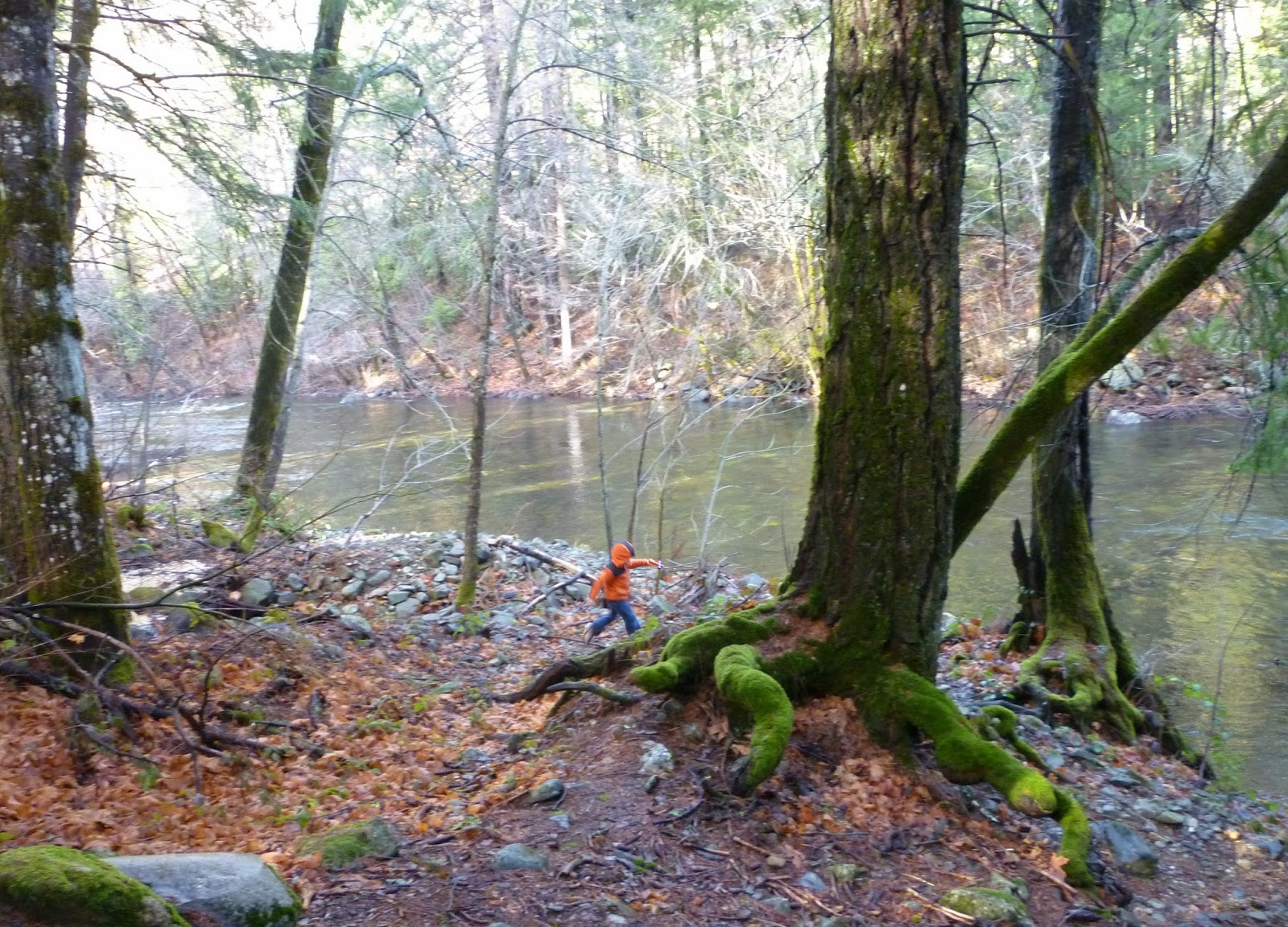
Another day we took a short trip to Castle Crags State Park and walked a trail alongside the Sacramento River. Considering the dryness of this year, I was amazed at the thick moss and ferns.


Port Orford Cedars like to grow next to rivers.
  
A pale green, almost white lichen grew on rocks and tree stumps.

yew trees on the riverbank
Grandson in orange jacket


Everything was wet from the recent rains, and many times our feet slipped on the invisible mosses -- or was it algae? -- growing on wooden bridges or river rocks.


Ivy practiced throwing pebbles into the river, and once she got the hang of it she did not want to do anything else. The supply of rocks was endless.

We went to the confluence of Castle Creek (in the foreground below) and the Sacramento River, from which you can get great views of the jagged rocks above, called the Castle Crags. They are high enough that the recent precipitation there was in the form of snow, and some was still unmelted and visible.


My dear husband showed me this large and artsy rock, which you can also see in the photo at the very top of this post, in its original setting. I wanted to take it home. It was a little too heavy for me to carry, so The Professor hauled it back to the car. It came with us on our journey home and is now living by our house. Mr. Glad classified it as a confluitic rock.

Winter days are short enough that at the end of our busy days there was plenty of time for cozy gatherings in the kitchen or by the wood stove. I read many books to the children. Scout's current favorite, which I read about on a blog before Christmas and gave to him, is Bumblebee at Apple Tree Lane, and we read it several times. Ivy likes The Little Fur Family best right now.

We danced to the children's favorite recordings, and also listened to bird calls on the Stokes Field Guide to Bird Songs CD. After ten minutes of loons and other waterfowl, Ivy must have deduced that those bird songs were some kind of dance music, too, and she started twisting and prancing around.

Hot soup is what you need on a winter's night, so Pippin and I learned how to make French Onion Soup, using the recipe in The New Best Recipe: All-New Edition by Cook's Illustrated Magazine. The secret that the Cook's testers learned is that red onions give the best flavor. Our result was sooo good.

And cookies! Pippin had some dough left in the freezer from her Christmas Peppernuts, the recipe that I concocted a long time ago but haven't made for years. We like our nuts to be nut-sized, so we always cut the frozen dough into little cubes and bake them long enough that they come out crispy. Next Christmas I'll give the recipe.

But for now, since I do love cookies, they make a good ending to my story 
of a wintry family visit that was warm and sweet.


Thursday, October 24, 2013

I praise Modoc, and question Jefferson.

Surprise Valley, California
It looks to me like some cowboy lost a piece of his shirt on this barbed wire. I took the picture when we were poking around in Modoc County, "where the West still lives."

Ten years ago our family met a cowboy who looked like The Marlboro Man himself, as we stood on a hillside watching him lead a string of horses through the sagebrush and across a creek, with pastel layers of aspens and mountains behind him.


This remote and rugged land is one of the areas that has perpetually been found within the proposed boundaries of The State of Jefferson, a longed-for 51st state that would include several counties in northern California and southern Oregon.
The modern Jefferson includes more counties.


Just last month the supervisors of Modoc and also those of its neighboring Siskiyou County voted to secede from the State of California, as the historic movement revs up again.


The Sacramento Bee reported:
[Mark Baird, one of the prominent activists] insists the State of Jefferson is the answer to revive logging, protect ranching and lure new businesses. He bristles at suggestions that these counties need to subsist on social services.
“It’s absolutely infuriating to people up here, this idea that we’re little children and we must have our hands held out,” Baird said. “Well, we would make our own way. We are intelligent, creative, hardworking people, and without the morass of failed social engineering experiments here, we would do fine.”
Barn in Yreka, in Siskiyou County, California
The Modoc county seat is Alturas, a word that means "valley on top of a mountain." Much of this country is considered High Sage Plateau, with evidently enough water for many cattle ranches and hay fields.

If I hadn't had a traveling companion to restrict my stoppings, I'd never have made it home for trying and trying again to get the perfect picture of black steers grazing on varying shades of green and yellow-green, with dark mountains behind them.

Nothing close to the perfect shot was to be mine. Either I was not high enough above the grassland to get the sweeping view, or the steers clumped up close to see if I were bringing their dinner, or, in the case of those next to our our motel in Alturas, they ran away when I was still 50 yards from the fence.
 
Many of these fine scenes were in Surprise Valley, which is even farther east than Alturas, east of Hwy 395, on the other side of the Warner Mountains. This valley's elevation, if you drive up and down Surprise Valley Road as we did, is above 4,000 feet.

The photo below looks still farther east, toward a band of tan that might be an alkali lake, and up into the Hays Canyon range of mountains that lie mostly in Nevada.

Looking east from Surprise Valley to the Hays Range in Nevada      


Besides your typical mountains, you can find the Glass Mountain Lava Flow on the western edge of Modoc County, though it lies mostly in Siskiyou County. On our previous visit we climbed on parts of that "mountain" and brought home huge pieces of obsidian and pumice. Everyone's shoes no doubt suffered a month's worth of wear on that terrain.

Glad kids scramble on Glass Mountain.

Murals on several buildings in downtown Alturas express aspects of the region that the residents appreciate. Modoc County has mule deer, herds of wild horses, Rocky Mountain elk, pronghorn, and birds galore. We didn't make it up to Goose Lake, but the bird mural makes me think of Goose Lake Valley, rich in all kinds of bird life. The painted fowl look as though they could fly right off into the real sky.

At the bottom of the mural you can see landscape such as we also noticed on our way up to Alturas, when the rich farmland gives way in places to slopes on which the soil is evidently too rocky and poor to support anything more than the occasional juniper tree. But the existence of fencing makes me think that in the springtime they might run livestock on the greened-up grass.

juniper trees


Fisherman
Pronghorn


    more murals


We ate breakfast at the Hotel Niles in Alturas.

I don't know about the Jefferson thing. It's a nice idea....can you believe we have a lot of family who reside in Jefferson counties both in Oregon and California? Probably none of our kin would be found at either of the cultural extremes within the succession movement, but at least one sports a license plate frame on her car declaring "State of Jefferson."
 
Nowadays there is a public radio station that claims the name, and people can attend the Jefferson State Hemp Expo, "...founded on the belief that through awareness, education, and the cooperation and coordination of citizens and public officials, many complex social issues can be solved." Note the emphasis on cooperation, not separation. Separation was formerly the goal of all Jefferson adherents, and a big part of the content of Jefferson as in its nickname "State of Mind." Currently it does seem that many of the people who use the name don't really expect anything to come of it. To at least a few it is probably just a brand they use to sell something.

another Surprise Valley view
At the other end of the spectrum, perhaps, are the hunters and most of the ranchers, and the politically conservative. This segment of the populace might include the woman who was noted in the police report column in the Alturas newspaper, which I perused while sitting on the bed in our motel room. She called the sheriff and said that if someone didn't speedily do something about the dog that was threatening her alpacas, she herself would "dispatch" the dog. I doubt that was the word she used.

Maybe the serious secessionists would include the people who shoot at Belding Squirrels during the Annual Squirrel Roundup. These are a type of ground squirrel that looks like a prairie dog, and their large populations damage the cultivated fields (I'm guessing it's by their holes and tunnels?), so once a year the residents hold a big fundraiser/pest-control event.

The giggling squirrel-shooter in this video I ran across is embarrassing, but you could turn off the sound, try to ignore the squirrels flying into the air, and see some nice footage of Surprise Valley in the background. The Roundup is held in March, so you will see less yellow and brown than in my pictures. If you make it to the very end you'll be rewarded with a view of Mount Shasta, something that would not be possible from down in Surprise Valley. The moviemaker must have driven back over the pass to the west at the close of day.


The likelihood of all these diverse Jefferson people agreeing to secede seems slight to begin with, and that's not the only challenging aspect of the project. Perhaps the nickname The Mythical State of Jefferson is the most appropriate. Whatever you call it, I do love this country.

On Cedar Pass, between Alturas and Surprise Valley

Friday, June 14, 2013

This morning had all of it.

the first red zinnia

 
"The early morning has gold in its mouth," said Ben Franklin. I bet he meant a different sort from what I found this morning. The birds started in earlier than ever today, at 5:00, but I was already awake!

lavender and salvia


After a while I realized that getting up was the thing to do. I just now read that some have called that moment when you get up earlier than you really wanted the Heroic Moment. Today was not that, because by the time I did throw off the blankets I was completely happy about the decision and it was easy to do.


sweet basil and nasturtiums competing


So often we have fog and cold feet in the mornings, but today was actually summery. The sun was shining, and the air had never taken on that cruel sharpness overnight - I could have eaten my breakfast outdoors at 6 a.m., but I didn't even think of it. The windows and door were open and I listened to the birds and marveled.


Early Girl is growing fast.


I walked around in the garden and took pictures of the flowers before the sun had a chance to get up high and glare at them.


My early morning had gold and silver and rubies and diamonds and all was bathed in the glory of God.


Tuesday, April 9, 2013

Blowing over tulips and into turbines...


When the spring winds blow, the howling through the trees and the chimes of the patio bells drown out the call of the garden so that I can listen to the world's discussions on many matters, including -- wind! Wind power, to be precise, and wind farms.


I had no idea that those scatterings of wind turbines on the Altamont Pass east of San Francisco were called farms. When a new turbine is installed they even call it a planting. Altamont is the wind farm I am most familiar with, but now I've seen photos of much more beautiful and even brilliant settings for these harnessers of wind energy, such as tulip fields in The Netherlands.


Turbines neatly lined up along a canal or placed here and there among what is primarily a tulip farm don't impress me the way they do when spread over hills that would ordinarily be drab without them. In those cases, like the slopes in California that in summer turn golden brown -- or a brown that is just plain dull -- the wind turbines grace the slopes with dynamic art.

I haven't taken the time to exit the freeway and drive to a good vantage point, but I think that one man who did got some lovely pictures that capture the beauty. The most artistic photographs cost more than I'm willing to pay for permission.

Several colorful photos are on the Pattern Energy site, gorgeous shots of their turbines at installations in Manitoba, Nevada, California and Texas. And some of these pages I'm linking to tell the stories of wind farm controversy in more depth than I will, so you might like to visit them for that reason, too.

The problem with the turbines is that they kill birds. The ones on the Altamont Pass kill more raptors than any other wind farm in the world, including the protected Golden Eagles, of which the world's largest breeding population lives in this area.


This article explains that worldwide the deaths from wind turbines are a small fraction of total bird deaths from run-ins with manmade structures such as office buildings, power lines and our houses; who hasn't experienced the dismay of hearing a small bird hitting - whack! - against a window? Even nuclear and fossil-fuel plants kill more birds than these converters of wind energy.

But it has been found that the more modern wind turbines, which are taller and slower, kill a much smaller number of raptors. So the old ones are being replaced. Bird and bat mortality are the topics of this site, annoyingly formatted but with useful links and an explanation of why Altamont wind turbines have been particularly deadly for birds.

Driving along Interstate 5 in California, we more than once have passed a truck carrying one turbine blade. These things are huge!

 Here is a photo of a "re-planting" of a turbine.

If I were to take a trip past those fields of wind turbines this month the scene might be greener and wetter, something like this.

The labor and intelligence of mankind that is applied to growing tulips results in a product that gives delight to millions of people. The wind turbine is an elegant result of technology, a thing of beauty in itself for its simplicity of design, but also as a symbol of man working with nature and using the gifts of the Creator. Thanks to God for putting some of His own creativity into us His creatures. May the glory go to Him.


Saturday, January 26, 2013

Bodega and Stories of Horror


Portuguese Beach - Sonoma County
This week we tripped over to the coast with Mr. and Mrs. C. A walk along the shore north of the town of Bodega Bay was first on the leisurely agenda. Schoolhouse Beach was closed, so we drove a little farther north to Portuguese Beach. It's steep where the waves break on the sand, and signs warn you not to turn your back to the surf or to go on the down side of the slope, where an undertow can get you in its grip.

The View Landward

We strolled the length of the beach and back, admiring the view landward and seaward, and then sat on a log. Mr. and Mrs. C didn't have their frisky Yellow Lab with them, but we've seen how she loves to romp in the water at Lake Tahoe or at nearby Salmon Creek Lagoon.

As we were climbing back up the cliff to the car, we met a couple coming down with four dogs, no matter that pets are not allowed on that beach. A tall great dane, two medium dogs with long hair, a tiny dog, and their owner carrying colorful beach ball.

Drowning at Portuguese Beach in 2011
We stopped at the top for a while and watched the Dane canter around joyfully. The mid-sized dogs pushed the beach ball into the waves and along the ocean's edge -- all right at that steep part that is so dangerous. Mrs. C. commented about how many people go into the ocean to rescue their dogs; the people often drown, but if they only had known that dogs almost always manage to get back on their own....

When I was researching for this post I discovered a news story and photo depicting a case of that very thing: a dog owner having drowned when she went after her dog and got caught in the surf. That time the dog did drown also, and it was at just this time of year. These accidents, though not always involving dogs, happen so often on the Northern California coast that the multiplied effect has turned them into horror stories for me.

"Birds" children running downhill from schoolhouse
A bit inland from Bodega Bay, we came to the town of Bodega. Confusing, isn't it? Both are famous for the Alfred Hitchcock movie "The Birds" being filmed here in the early 1960's.

I saw it in my teens, and can still recall sitting on the living room floor, self-consciously and silently terrified. Ever since then, when I see crows looking down from telephone wires, I know from the experience of that movie that they have a sinister intent.


The schoolhouse today, a private residence

Hitchcock mixed up scenes from the two towns for the film, and we checked out two of the landmarks that remain in Bodega: the schoolhouse and the church, which stand very close to one another on a hill. Within the last year we Glads and the C. couple watched "The Birds" together. It wasn't as scary as I remembered, but I still don't like it. I do like the buildings in Bodega.


On our way back from the beach we first stopped at a historic watering hole in the town; the Casino's bar was built a hundred years ago by the bartender's great-uncle. His grandmother still manages the place, opening the doors and closing up every day even in her 80's.

The dining room (the sign said "Dinning Room") was most appealing to me. It was fresh and clean and empty that afternoon, tables, chairs and floor of bare weathered wood as old as the bar. A dozen or more deer and elk heads decorated the walls around. I drank an Ace Peary Hard Cider, brewed locally.

After our refreshment we walked along a muddy little track through the grass along the bank above the road, to see the church and the school.


The church is St. Teresa of Avila. Services have been held there weekly since its dedication in 1861. From the church you can look down on the little artsy town of Bodega, as in the photo below.

When we had set out from our house that morning, I decided not to bother with a camera. Then of course I regretted it many times! I was lucky to find all of these pictures on the Web.

I'm happy to say there was nothing horrific about our meandering day. That's a good thing about enjoying the present moment: one doesn't have to be subject to artists' imaginations, to old news articles, or to one's own memories of bad things. "Sufficient to the day is the evil thereof," and as there wasn't any of that sort of thing on our outing, it provided sufficient R&R for my weary soul. Thanks be to God!


Town of Bodega, California