Showing posts with label music. Show all posts

Thursday, February 13, 2014

wintertime loves


We in the arid parts of the West have been exulting in rain the last week or so. It's so comforting and even glorious to wake in the night and hear the rain still coming down. Then to wake in the morning and see it is still falling. We had puddles in the back yard! Thank you, Lord!

Mr. Glad and I do live in northern California, but daughter Pippin lives even farther north in the state, and we drove there early this week for a short visit. Often February is a very snowy month at her place, but this year they've had more dry weather and rain than snow, and even the rain stopped while we were there, so we could get outdoors easily for work and recreation.


One day we made a family project out of pruning old apple trees that Pippin and The Professor are trying to revive from years of neglect. I floated back and forth between lopping branches and swinging the kids.


I would get Scout and Ivy going and then run over to take a picture of the adults on ladders.


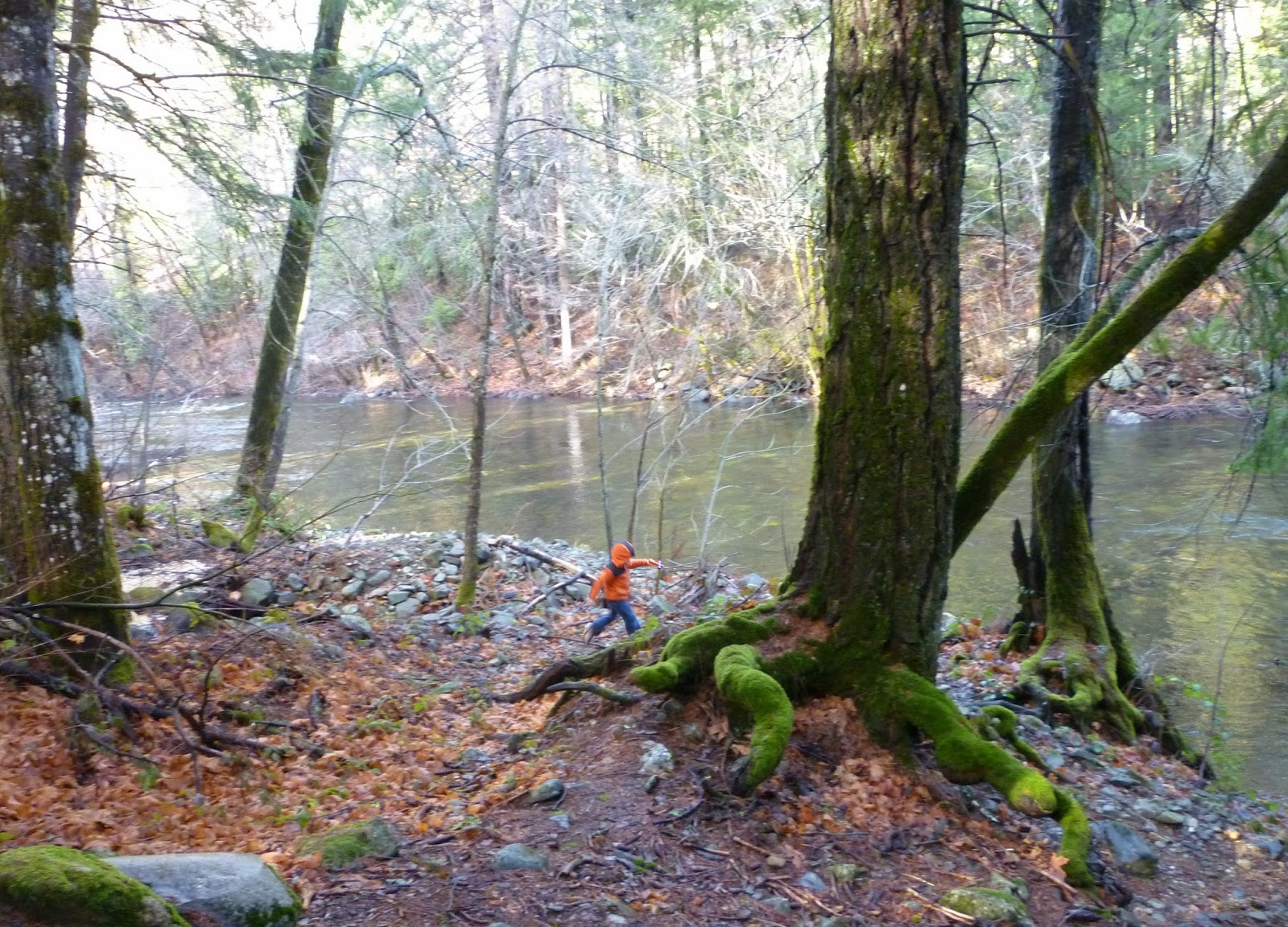
Another day we took a short trip to Castle Crags State Park and walked a trail alongside the Sacramento River. Considering the dryness of this year, I was amazed at the thick moss and ferns.


Port Orford Cedars like to grow next to rivers.
  
A pale green, almost white lichen grew on rocks and tree stumps.

yew trees on the riverbank
Grandson in orange jacket


Everything was wet from the recent rains, and many times our feet slipped on the invisible mosses -- or was it algae? -- growing on wooden bridges or river rocks.


Ivy practiced throwing pebbles into the river, and once she got the hang of it she did not want to do anything else. The supply of rocks was endless.

We went to the confluence of Castle Creek (in the foreground below) and the Sacramento River, from which you can get great views of the jagged rocks above, called the Castle Crags. They are high enough that the recent precipitation there was in the form of snow, and some was still unmelted and visible.


My dear husband showed me this large and artsy rock, which you can also see in the photo at the very top of this post, in its original setting. I wanted to take it home. It was a little too heavy for me to carry, so The Professor hauled it back to the car. It came with us on our journey home and is now living by our house. Mr. Glad classified it as a confluitic rock.

Winter days are short enough that at the end of our busy days there was plenty of time for cozy gatherings in the kitchen or by the wood stove. I read many books to the children. Scout's current favorite, which I read about on a blog before Christmas and gave to him, is Bumblebee at Apple Tree Lane, and we read it several times. Ivy likes The Little Fur Family best right now.

We danced to the children's favorite recordings, and also listened to bird calls on the Stokes Field Guide to Bird Songs CD. After ten minutes of loons and other waterfowl, Ivy must have deduced that those bird songs were some kind of dance music, too, and she started twisting and prancing around.

Hot soup is what you need on a winter's night, so Pippin and I learned how to make French Onion Soup, using the recipe in The New Best Recipe: All-New Edition by Cook's Illustrated Magazine. The secret that the Cook's testers learned is that red onions give the best flavor. Our result was sooo good.

And cookies! Pippin had some dough left in the freezer from her Christmas Peppernuts, the recipe that I concocted a long time ago but haven't made for years. We like our nuts to be nut-sized, so we always cut the frozen dough into little cubes and bake them long enough that they come out crispy. Next Christmas I'll give the recipe.

But for now, since I do love cookies, they make a good ending to my story 
of a wintry family visit that was warm and sweet.


Tuesday, December 24, 2013

The Huron Carol


My favorite "Poem A Day" blog that was written by Maria is not currently active, but its archives remain online, a treasure store of poetry and art. This Christmas post that I read in her collection is titled Jesus! Ahatonhia! It's a heartwarming telling of the Christmas story.

In that entry Maria shared "The Huron Carol," which was composed in 1643 by a Jesuit missionary who lived and worked with the Indians in what is now Ontario, Canada. He was French, and though he wrote the lyrics in the Huron language, he set them to a 16th-century French melody, "Une Jeunne Pucelle."


You can listen to the song on YouTube; the version I put here has singing in French and English as well as what I take to be Huron. The story is about an angel who appeared in the Northern Lights to tell the Indians about the Christ Child. A series of three stamps commemorating the carol were issued in Canada in 1977.

My favorite stanza:
The earliest moon of winter is not so round and fair
As was the ring of glory on the helpless infant there.
And chiefs from far before Him knelt with gifts of fox and beaver pelt:
Jesus, your King, is born;
Jesus is born,
In excelsis gloria!
Amen! And Merry Christmas to you all!


Tuesday, December 17, 2013

It cheers my heart like spirit'l wine.

I have just discovered the 18th-century hymn "Jesus Christ the Apple Tree," on this G.K. Chesterton site., where you can read good meditations on its meaning. It is thought to have been written by a New Englander, and has been set to various tunes. The most common seems to be the one by Elizabeth Poston, of which this video records a nice rendition.


The hymn has become associated with Christmas, and I'd like to add it to our own family's collection of carols, at least by next Christmas. "Under the shadow I will be, Of Jesus Christ the apple tree. "


Thursday, August 29, 2013

What'd life be without 'em?


My title is a line from Guy Clark's "Homegrown Tomatoes," a song that's running through my mind these days when our tomato harvest is nearing its peak. I've never weighed one day's pickings before yesterday's harvest, pictured below, which came it at about 13 pounds. I'm sure everyone has had quite enough of my tomato reports, so I'm including a little music to reward your patience.
 

Friday, July 26, 2013

My gleanings include rubbish and pies.

I guess I've had enough time and thinking power this week to read and ponder, but my activities didn't result in anything of my own to posit or report, so I'll just pass on some recent gleanings.

Women Priests?  I love it when a reviewer is bold enough to say "This book is rubbish." Honesty and confidence! Although, if that's all she can say, she won't get a hearing; I want to hear reasons for her belief. I just read this blog post titled "Merlin Stone's book is rubbish", and though I had never heard the author's name before I immediately wanted to read that article.

It's a brief review of  When God Was a Woman, which the blogger first had to read in seminary years ago. She writes, "There is neither historical nor anthropological support for her thesis that the Hebrews suppressed goddess worship. She tries to prove that the Canaanites had a matriarchial and matrilineal structure. She is wrong on both counts." Go to the blog Just Genesis to read the supporting details. The writer always has lots of fascinating historical and archeological knowledge to pass on.

Pies, pies, pies... Three women collaborated on a book, which as soon as I read about it I had to have sent as a birthday gift for my granddaughter. It may be a bit early for her, but I like to encourage little girls to start taking a creative role in the kitchen and to look to real grownups for inspiration.

The book is Pieography, written by Jo Packham, Food Styling by Anne Marie Klaske, Photography by Traci Thorson. All of these women have blogs; Jo and Traci feature photos of some pies, but I think you have to get the book if you want the recipes and stories.

I haven't seen the book yet, but I've enjoyed Anne Marie's blog in particular. The clean and elegant style is nice to surf around in and see snippets of the Klaske Family's farm life. On Thursdays you can get inspired to bake pies!

Death of the Old Man:  Father Stephen Freeman shared a link to his daughter's blog, on St. John of the Cross and the loss of identity, or the Dark Night of the Soul, or the "death of the old man." Actually the subtitle of the post is "The Loss and Discovery of our Identity in God" (italics mine), so it ends on a very positive note, to be sure.

She writes, "If we had always thought of the death of our old man as purely symbolic, it may come as something of a shock to think of real pain being involved. But when our turn inevitably comes to go through pain or tragedy, then we may take comfort in knowing that many have travelled down this path before us."

Icons and Images:  A book on the history of the use and theology of images in Jewish culture and in the church is the subject of this blog post on Orthodox-Reformed Bridge. Early Christian Attitudes Toward Images is written by Stephen Bigham, and a series of four blog posts is planned to review the book. This structure follows the organization of the book:
The book is divided into four chapters. Chapter 1 deals with the “hostility theory” which holds that the early Christians were hostile toward images. Chapter 2 deals with early Jewish attitudes toward images. Chapter 3 deals with the early Christian attitudes towards images, that is, the pre-Constantinian period. Chapter 4 deals with Eusebius of Caesarea who witnessed the beginning of Constantinian era.
The author is an Orthodox priest, and the blogger Robert Arakaki was Reformed in his theology before converting to Orthodoxy. I'm looking forward to reading all the reviews of what looks to be a thorough treatment of the subject.

Beethoven in Space:  Lastly, here's a music video featuring Hubble images and beautiful music. A blessed weekend to you all!


Wednesday, June 12, 2013

This chock-full week in June...


In church, we will soon be celebrating Pentecost, on the 23rd of June. Last night was the Leavetaking of Pascha service that I love, the last time we would sing "Christ is risen from the dead, trampling down death by death!" in the services until next Pascha. Tonight the Feast of Ascension began; until Pentecost we greet once another with "Christ is ascended!" and the response is, "From earth to heaven!"

loaves proofing
Between now and October 1st our parish has many feast days, so our team of communion bread bakers has a busy season ahead. Yesterday three of us worked at making the large loaves used in the altar, and the photos show some of my efforts.

just after sprinkling on some curry spices
At home I'm reveling in glorious vegetables. In the last few days I've juiced lots of vegetables raw, and also made big batches of kale and Turkish Green Beans and stir-fried Asian vegetables.

My recent favorite way to cook sweet potatoes or yams is to roast them at 450° or 500° with coconut oil and curry powder. I don't measure anything, and have used varying amounts of all the ingredients -- also different blends of curry spices, plus a little salt. It doesn't seem to matter if I stir the spices in at the beginning or partway through the baking. I bake them till they are tender. And then I eat them like candy.


Pippin sent me a link to this photo journal of grandmas around the world and the food they cook. I am considering what dish I might pose with were I asked to participate, and what clothes I could wear that would make me look half as cute as the Bolivian grandma in the collection....you're right, it would take more than clothes. I love the way the women arrange the ingredients so artfully in the "before" photos. An example is below.

The Egyptian grandma looks pleased.
From our son Soldier we got a link for a short film you can watch online (less than 15 minutes), about a man in the mountains of Ecuador who is The Last Ice Merchant. It's always a joy to see footage of a human soul taking satisfaction from hard work well done.

But progress means that people can get factory ice cheaply and the old-style ice he sells has become a specialty item. It's not likely anyone will want to take up the cause of nostalgia once he is gone. But I wouldn't be surprised if the ice he hauls down the mountain is sweeter than the cheap and more convenient blocks.

The last ice merchant
Another man whose character inspired me this week by way of the movie "Searching for Sugarman" is Sixto Rodriguez, a singer whose music never took off in the U.S. His two records failed to sell, and he lived simply and humbly for decades after, not knowing that his music was hugely popular and motivating and successful in South Africa. When his fans there discovered that he wasn't dead as rumored, they brought him to that country to do several concerts.
Rodriguez

Suddenly he is famous -- but he didn't lose his endearing simplicity and generosity. I was impressed at how he seemed to have passed his gentle spirit on to his daughters who are also introduced in the film. I liked all but one person in this documentary, and I liked Rodriguez's voice very much, and a couple of his songs.


There you have my happy hodgepodge. Oh, and here is what my Mother's Day lily looked like when we got back from Oregon.

Saturday, May 11, 2013

The Music of My Life

The third chapter of The Hidden Art of Homemaking is the impetus for this post. It is titled simply "Music," and continues the theme of how Christians might express their creativity in their varied and unique circumstances. I am participating in the discussion of the book on Cindy's blog, Ordo Amoris. This is a long post and I apologize -- you would be smart to skip it and go do something creative!

It might have been 30 years ago that I first read Hidden Art, and I wrote on the day of the author's death how important it was in developing a vision for my life. At the time of its publication in 1971 I don't think there was anything else like it, but feminists were writing plenty about the stifling life of the typical housewife. It was lovely to have laid out before me many concrete examples of interesting people and their home-enriching activities.

Just a couple of years later, Karen Mains wrote Open Heart, Open Home, which also contributed to my Christian vision, on the theme of hospitality. And I was married in the early 70's, and enjoying keeping house and garden even before the children started arriving. When the house started filling with kids, I never lacked for creative projects and plans.

But I hadn't even read Schaeffer's book yet. My young-married-childbearing years were overflowing with culture and creativity, and I could not relate to the reader Edith seemed to be writing for, someone who is frustrated, locked up, or unfulfilled (her words).

Only recently have I been able to look back over my life and see with more understanding (I hope) why the story reads the way it does. I needed time to think, and I needed to see more of the plot toward the end, before I could notice how the first chapters fit with middle parts of my saga.

Part I contained an excess of family drama, as we call it these days, emotional and psychological stress that I didn't get any help dealing with. If you have a splitting headache it is hard to tap into your creativity. It's the same with emotional pain, maybe more so when it isn't diagnosed or even acknowledged, but stays like an always-freshening wound that makes you want to move as little as possible.

Me in Part II
What brought me into Part II was getting married to a good man and empowered to create my own story, free of distracting pain. The setting was calm and clear and full of the hope of the gospel. It was somewhat the opposite of what Schaeffer talks about, because being home was my obvious opportunity to do just about anything. I had had no lack of examples and ideas; actually, the hippie era for me segued into a homesteading spirit a la The Mother Earth News. And there were all the creative people I'd known growing up (just about everyone), while I was storing up tinder for my creative fires.

I see that I have mixed a few metaphors here trying to tell my story -- or am I writing the score for the symphony that has been playing out? Though this chapter is about music, it seems as good a place as any to bring up what seem to me to be realities on which our artistic life is built. They apply to music, too.
 
I received little musical training as a child, and I had no career that I had to put on the back burner. But growing up in church was good ear-training, and even in the Girl Scouts and in public school we sang a lot. I was lucky to marry a musician, and by means of his guitar and my singing we filled the house and our children's ears with music.

We sang in the car, using songbooks I wrote out by hand. We sang around the campfire. We parents sat on the bedroom floor and crooned lullabies to our children every night. And in church I helped the young readers to develop fluency while hymn-singing, running my finger along the page under the words while they looked on. But I don't know how to read music.

At first there wasn't money for music lessons, and I wept over the injustice of a world in which my firstborn had no opportunity for a more structured musical education. Then grandparents and great-grandparents stepped in and God provided a generous piano teacher two blocks from our house. From that time forth the provisions continued in various ways, so that eventually all of our five children learned to play at least one instrument. The photos are of them and a grandson enjoying their music. Two of our daughters became piano teachers in their teens.

But for many families, music is not something they can really accomplish. My parents could not provide it for me, but it all worked out o.k. Some women find that their distracting drama only starts when they marry, or when a child falls ill. There are women for whom getting through the day is like climbing a steep mountain, and while they might be relieved to stop and smell the flowers, it's asking a lot to tell them they ought to get out the seed catalog and develop a plan for further landscaping. But I suppose they aren't the ones reading Hidden Art.

When Schaeffer says things like, "Christian homes should...be places where there is the greatest variety of good music," I balk at the word should. I don't know how she might otherwise have presented a picture of what she considers the ideal home, but every time she says we should do this or that to develop our creative side -- and in the short Chapter 2 she used the word nine times -- I get annoyed that she is telling me what my Christian duty is.

It just seems backward to me, because I can't recall ever doing one creative homemaking thing out of a sense of duty, though I firmly believe we are all obligated to do our duty. To fear God and keep His commandments is the whole duty of man, according to Ecclesiastes (Not that we can even accomplish those basics on our own). It seems to me that the rest, the art and music and beauty, flow naturally from a human soul that is nurtured by God's love -- just as sap running up a tree trunk results in bright leaves and colorful fruit. The main thing is not to tell the tree to make fruit, but to keep the connection to the life-giving Fountain -- Who is also the One who heals all those diseases of the heart that might hinder us.

What do you know -- beauty in our life is one of the healing potions God provides. So if we start with small things that brighten our homes, say, singing a few lines from a hymn over the kitchen sink, or teaching a nursery rhyme to a toddler, just in response to the impulse, we are creating culture and feeding our own souls. It keeps the sap running, and the more the tree grows, the more sap and delicious fruit there will be.

Since Edith Schaeffer wrote this book and What is a Family, the only two of hers that I have read, thousands of families have discovered that homeschooling provides the opportunities to build the kind of family life and culture that the author presents a vision for. Just give us enough time with our children and all these good things are more likely to happen. The vision she sets forth was an ingredient in the soil that nourished my own heart and gave me the courage I needed. All the rest is in Part II, Part III, and still writing... Oh, and still singing new songs!


Friday, May 3, 2013

Christ accepted the impossible death.

He died although he cannot die; he dies although he is immortal, in his very human nature inseparably united with his Godhead. His soul, without being separated from God, is torn out of his body, while both his soul and his flesh remain united with the Godhead. He will lie in the tomb incorruptible until the third day, because his body cannot be touched by corruption. It is full of the divine presence. It is pervaded by it as a sword of iron is pervaded by fire in the furnace, and the soul of Christ descends into hell resplendent with the glory of his Godhead.

The death of Christ is a tearing apart of an immortal body from a soul that is alive and remains alive forever. This makes the death of Christ a tragedy beyond our imagining, far beyond any suffering that we can humanly picture or experience.

Christ's death is an act of supreme love. It was true when he said, "No one takes my life from me; I give it freely myself." No one could kill him -- the Immortal; no one could quench this Light that is the shining of the splendor of God. He gave his life, he accepted the impossible death to share with us all the tragedy of our human condition.

--Metropolitan Anthony Bloom

This hymn of Holy Friday, of which I found a version on YouTube, begins, "Today He Who hung the earth upon the waters is hung upon a tree," and continues with an exploration of all the impossible details. At Royal Hours this morning I heard a quartet of men sing it, fittingly beautiful and powerful.


Thursday, January 17, 2013

I see in the glass darkly.

When I married my husband, I married into his family. If that family were a building made of earthly stones, the large rock that for so long stood at the corner of the foundation, the one that bore the most weight, has been taken out of his place. He passed from this life last week at the age of 96. My husband's father was a Christian man and there was nothing fancy about him; still, many people said rightly that he was "a prince of a man."

The house is being restructured. We know that God's everlasting arms are under us in any case, but I feel the shifting, and the huge change. And I could not think of a thing to say here until today when I read these words from a hymn of the Greek Orthodox Rite for the Burial of Priests. This man who was so significant in my life was not a priest, or even Orthodox, but the hymn helps me to pray and to hold the mysteries in faith.

God intended the soul and body to be a unity, but at death they have to be torn apart. The words wonder about that and about other things regarding our death of which we understand so little. I like the musical setting by John Tavener; you can read the words below the link while you listen to the hymn.

And let us do as exhorted at the end, to enter into Christ, and His Light. Amen.


Why these bitter words of the dying, O brethren,
which they utter as they go hence?
I am parted from my brethren.
All my friends do I abandon, and go hence.
But whither I go, that understand I not,
neither what shall become of me yonder;
only God who hath summoned me knoweth.
But make commemoration of me with the song:
Alleluia.

But whither now go the souls?
How dwell they now together there?
This mystery have I desired to learn,
but none can impart aright.
Do they call to mind their own people, as we do them?
Or have they forgotten all those who mourn them
and make the song:
Alleluia.

We go forth on the path eternal,
and as condemned, with downcast faces,
present ourselves before the only God eternal.
Where then is comeliness? Where then is wealth?
Where then is the glory of this world?
There shall none of these things aid us,
but only to say oft the psalm:
Alleluia.

If thou hast shown mercy unto man, O man,
that same mercy shall be shown thee there;
and if on an orphan thou hast shown compassion,
the same shall there deliver thee from want,
If in this life the naked thou hast clothed,
the same shall give thee shelter there,
and sing the psalm:
Alleluia.

Youth and the beauty of the body
fade at the hour of death,
and the tongue then burneth fiercely,
and the parched throat is inflamed.
The beauty of the eyes is quenched then,
the comeliness of the face all altered,
the shapeliness of the neck destroyed;
and the other parts have become numb,
nor often say:
Alleluia.

With ecstasy are we inflamed if we but hear
that there is light eternal yonder;
that there is Paradise,
wherein every soul of Righteous Ones rejoiceth.
Let us all, also, Enter into Christ,
that all we may cry aloud thus unto God:
Alleluia. 


He is the Resurrection and the Life

Thursday, June 7, 2012

Maui Diary 11 - Aloha Oe


On Maui we stayed in the town of Kihei, where 50% of the permanent residents of the island live. This plebian environment was more our style than the resort life we observed just south on the beaches next to Wailea's villas and grand hotels. Just strolling on the beach path that winds past their perfectly groomed and gorgeous grounds, I became a little self-conscious about my commoner's clothes every time we passed the hotel guests.

Staying in a condo rather than a hotel also made for a relaxing and homey existence, at least for people like us who like to set up housekeeping for ourselves and actually prefer to eat breakfast "at home." We bought sweet Maui Gold pineapples at Safeway and ate of them in the morning while I was still in my nightgown. Each of us had one day that we were under the weather, and we could just laze about our apartment, and grill steaks or fish for dinner on the barbeque outside.


Our place had a view right out to the beach, and one evening I sat in front of this scene and counted 27 palm trees within my range of vision. The stars came out and were as bright as in the high mountains; I couldn't get over how well I could see without my glasses Orion's belt and even his sword.

I wouldn't complain if someone gave me a week at a resort and I had to eat at its restaurants, but as long as I'm paying, I'd just as soon stay in a less expensive condo like the one we were blessed with and enjoy the food at the many places the locals also enjoy.

The Coconuts Cafe with its deservedly famous fish tacos is a fine example. The cole slaw, normally in the tortilla but which I had on the side, was made with a refreshing coconut milk dressing that I'd love to try replicating.

Mr. Glad has for some time enjoyed Hawaiian guitar music, so we had looked forward to being in Hawaii and hearing some good examples. One evening we went out for some live sounds that turned out to be not that great and not traditional, but the luau on our last night was fulfilling and very fun in its historically accurate dancing and music.

Over the radio in our rental car we heard a new-to-us contemporary Hawaiian sound that was maybe not traditional musically, but in the easy-listening messages conveyed it was all about loving the motherland and listening to the forefathers who will teach you how to be honorable Hawaiians.

Shirt Mr. Glad gave me for my birthday
This harkening to cultural roots and the ancestors generates a desire on the part of parents to put their young children into classes where they will learn the Hawaiian tongue. It seems that though Hawaiian names and phrases are floating through the balmy air everywhere, currently very few people actually have any real ability to communicate in that language. I wonder if that will change, or if the children force-fed this artifact will respond with disdain as have the Irish I know who were made to study Gaelic in school.

Besides the reverence for the land and the history, we noticed in the popular and melodic songs we heard a phrase repeated in nearly every one: ka puana. Eventually we were able to investigate and discover that this means something like "It's fun to be with you." It often went along with words about Having a Good Time, which easygoing theme was one of the unique scents in Mauian atmosphere.

How would it be, we mused, to live as a permanent resident in this place, where one might reasonably believe that even people with jobs and families display the Hang Loose symbol and attitude? It's almost certain that we will never know the answer, even if we sojourn there again.

Ages ago, at my 8th grade graduation, our school chorus sang an English version of the Hawaiian tune "Aloha Oe," ("Farewell to Thee") and it made a big impression on me, so that I can still remember some of the words in our translation, and find that they don't exactly match anything to be found online.

At least I did find a nice guitar rendition of the tune (just below), with lovely pictures, to wrap up my Maui Diary. As you will guess, many of the pictures are of scenes I didn't see, but they convey something of the Hawaiian heritage and natural beauty.


I won't end with that video that someone else put together, because I do have one of my own making! It was recorded on a windy afternoon on the beach by our condo, so the only sound in the movie is that of the tradewinds. It's a 360° view, starting on the beach, and taking in a row of condominiums. Ours was the flat-roofed one somewhat in the middle.

And at the very bottom of the page, the refrain of the song as I remember singing it. Good-bye, Maui! Until we meet again....


Aloha Oe, Aloha Oe,
The winds will carry back my sad refrain;
One fond embrace before we say good-bye,
Until we meet again.

Friday, January 20, 2012

Rain Songs

Rain is falling and I'm happy. Recently I refreshed my memory bank of rain songs by means of the recording, "Rainy Day Dances, Rainy Day Songs," by Patty Zeitlin and Marcia Berman. We used to borrow an LP from the library when the kids were little, and the songs have lodged in my mind forever.

On the recording there was also an instrumental tune, "Over the Waterfall," played on the hammered dulcimer. I can't find anything on YouTube by the musicians who gave us this collection that so blessed my children and me, but I did find a similar, simpler rendition.


I loved the silly dancing and singing we did to songs like "I Don't Care if the Rain Comes Down," "Windy Day," and "Why Can't I Play in the Rain?"

I bought my CD copy of the album from the Bullfrog Ballades site, where you can also hear samples of the songs. Today I'm having a lazy day being thankful that God is watering the earth again, as I let my thoughts slosh about in rainy images like this one of me (on the left) with my sister a long time ago. If you can't play in the rain, perhaps a puddle will do.

Wednesday, December 14, 2011

Snowmen and Jello - Christmas


Two Glad Grandboys
While we are waiting for Christmas and preparing our gifts, and thinking about what Santa and our parents are preparing for us, children are lucky if we have some snow around with which to build a snowman or snowlady.

My own grandchildren sometimes have that. But when I was a child, I only had the beloved "Frosty the Snowman" 45 to play on my little record player.

It's the only record I remember from my youth until I bought such ones as "Like a Rolling Stone," and I listened to the Frosty tale over and over so that I can still hear the voice -- maybe it was Red Foley -- in my head. On the other side he sang "Rudolph the Red-Nosed Reindeer." The image below is not quite like what I owned, but it evokes the memory well enough.
 

I remain snowless, and don't mind a bit. Besides, I can watch "The Snowman" on video. Those who lack the technology for watching movies (and I know there must be some of those people still, though they are probably not the ones reading this) could read the wordless book The Snowman.

But the video is so enchanting, with its haunting tune. The first time I borrowed the movie from the library, it was a version with the song, but since then I have only found it with a purely instrumental score. We are all fortunate now, and I am more than pleased, because I can share with you what I found on YouTube, a clip that includes sung lyrics of "Walking in the Air."


When I turned fifty a friend took me browsing in a quilt shop to pick out a few pieces of fabric as a birthday present from her. Several prints called to mind images from the adventures of the snowman and his little boy, and I took rectangles of them home with a theme brewing.

I sewed by hand several potholders that I call my Snowman Potholders. Of course, they have nothing to do with Christmas, except for their frequent role in pulling pies out of the oven for Christmas dinner.


Waiting....We Orthodox are still waiting until December 25 (or January 7) for the feast and waiting to feast, because we are preparing our hearts, which are tightly bound to our bodies. But participation in the Advent fast needn't mean that children of any age must forgo all goodies. I made this festive rainbow jello for one Christmas Day, but while we are still fasting it seems to me it could easily be made with some soy or coconut milk replacing the small dairy part of the recipe.


RAINBOW RIBBON DESSERT

1 (3 oz.) package (each flavor) raspberry, lime, orange, lemon, and strawberry Jell-O

6-1/4 cups water
1-1/4 cups evaporated milk

Dissolve raspberry Jell-O in 1 cup boiling water. Remove 1/2 of Jell-O to a bowl and add 1/4 cup cold water. Place into a 9-inch square pan. Place in refrigerator until slightly firm. To the remaining half of Jell-O, add 1/4 cup evaporated milk. Cool and place over slightly firm layer in pan. Continue procedure with remaining flavors of Jell-O in this order: lime, orange, lemon, and strawberry. Cool each mixture before layering. Chill completely. Cut into squares to serve. Yield: serves 8 to 12. 


Now I'm trying to figure out how to tweak this colorful recipe into a frozen dessert. It already has the brightness of Tolkien's wintery image, and I think I might attract my snowmen friends to my holiday table if I just advertise that for dessert we are serving a treat called "Northern Lights."


(This is the third in my contributions to Pom Pom's Childlike Christmas Party.)

Saturday, November 12, 2011

Glorious Mud

Homeschooling Beach Babies enjoy playing in the mud. The sight of these darlings and the memory of my own children in similar settings brought to mind the song I used to sing to them. Nowadays it's easy to find such things on YouTube, which I did.

It turns out what I had gleaned from who-knows-where was only the chorus of a long song titled "The Hippopotamus," by Flanders and Swann, which tune and words form the soundtrack of a suitably watery video.


One can find the words of the verses online, but they aren't really for children. The chorus alone was sufficient to spark up our family's muddy excursions, and it goes like this:

Mud, mud, glorious mud,
Nothing quite like it for cooling the blood.
So follow me, follow,
Down to the hollow,
And there let us wallow
In glorious mud!

Have fun!

Thursday, September 1, 2011

Funny Wasp Thing

The wasp approached in the afternoon as I was sitting on a leafy patio listening to my companions' leisurely conversation. He quickly got down to business and stung the back of my knee. I don't recall ever having been stung by a wasp before, so I didn't know what to expect, having seen and heard of extreme reactions.

I decided to go inside the restaurant and ask for some ice to put on the spot, to calm things down, and when I got back I explained what happened. Nearly all the people sipping drinks under the umbrellas were nurses or doctors, so they wanted to be sure I was o.k., but after I assured them that the ice was working fine, we went on talking about other things in the world.
Yellow Jacket

But I haven't got to the funny part. On the drive home I had to leave off icing that still-stinging place, and it did start hurting again; the heat was spreading and stabbing a little, too. I'll just have to take some Benadryl when I get home, I thought.

I switched on the radio in the middle of "The Flight of the Bumblebee," but perhaps because it was not exactly a bee that had got me, I didn't think anything of it. At the end of that piece, the announcer said that after that he felt he really must play "The Wasp Overture" by Ralph Vaughan Williams.

I couldn't believe my good fortune -- or what was surely a little medicine custom-formulated by God. The remedy seemed to work, because by the time I got back to my town, the site of the sting was not swollen or painful anymore, and there was only a little red dot where that (probably) yellow jacket had attacked. Mr. Glad called it a musical form of homeopathy: like cures like.

I didn't even take the whole remedy, because the overture was still playing when I had to turn of the engine and go inside. It was a beautiful piece, more evocative of the lovely aspects of a summer afternoon than the wicked wasp himself -- that is, what I noticed of it.

Mostly I was amazed, as I listened, that anyone would compose music with that title, and that I was hearing it for the first time after my recent insect encounter. Since then I've learned that it was written for a production of Aristophanes' play The Wasps, and is a fairly popular piece. But at the time all I could think was, Could Vaughan Williams have written such a thing if he'd ever known a wasp the way I did that day?

Thursday, August 11, 2011

California Mountains - Rivers and a Song

(This is the 3rd installment of my July vacation travelogue.)

Lake Tahoe sits on the California-Nevada state line, and the rivers in the surrounding mountains form the setting of the ballad "Darcy Farrow." Ian and Sylvia were singing this song the first time I heard it, and I still think their rendition is the best. I heard many examples on YouTube while looking for one to post here.


As we drove down the highway south from the lake, we weren't far from "where the Walker runs down to the Carson Valley plain," and in fact we crossed all three rivers mentioned in the tale, the Truckee, the Carson, and the Walker. We even listened to Ian and Sylvia sing from the CD player at one point in our journey.

Of course I don't like that Young Vandy put a bullet through his brain, but in comparing this story with other traditional songs I find I like it better than ones where the young man instead kills his beloved by accident or out of anger.

These rivers descend toward the east from from the northern Sierras and always refresh my mind as I watch them from the car. The Walker stays close to the highway longer than the others, and where it flows through desert-like terrain it captivates me by the contrast it gives to the sagebrush-covered banks. It's fast and furious and carrying a lot of irrigation for the green fields of alfalfa grown farther east where the land flattens out. I recall those expanses of green and the beautiful Nevada cattle ranches in the shadow of the mountains -- but we didn't go that way this trip. 

Four years ago we visited this area, and I wrote hasty notes in my journal as we sped along through ever changing layers of conifers, sagebrush, aspens and meadows, trying to preserve the moments of beauty. I didn't get to catch my own photo of the rivers on either trip, but I found this one on the Web.

West Walker River

And below is one of ours, showing the mountains where the heavy snowpack from last winter is still melting and filling the rivers with icy water. On Hwy. 395 this far north the elevation is still above 5,000 feet so the summer temperatures don't get extreme. The cattle looked content, and I know I was.


Thursday, July 14, 2011

Bluesy Boots

Mr. Glad took me to a nearby art and garden festival mostly so we could hear some music for free. We browsed through some booths and considered buying a painting, admired hand-carved wooden bowls, and pottery. We bought pizza and wine and beer, and then stood near the back of the stage so my husband could keep an eye on the drummers.


Two bands performed during the time we were there: a Santana cover band, and the blues band of Tommy Castro. I didn't think of taking pictures of the first one, though their music was more to my liking -- very much so. And their drummer was amazing.


Quite a few people were dancing close to the stage, and that was fun to watch. I particularly liked one man's shirt with bright birds.


I couldn't make out most of the words to the Castro numbers. That band is famous in their genre, and I did enjoy listening, but after Mr. Glad pointed out to me that the musicians in the front were all wearing cowboy boots, my camera eyes were framing pictures everywhere. The drummer was wearing black athletic shoes, and he didn't seem to be working very hard, so I left him out.

The trumpeter, however, was impressive in his placidity, and for his long gray braid. And Tommy made sure to turn and face three directions from the stage in turn, so that we could all watch his fancy guitar-playing.