Wednesday, November 16, 2011

Librarian of Antiquities


Last night Mr. Glad and I traveled with some friends to Berkeley where we heard a lecture by Father Justin Sinaites, who is the librarian for Saint Catherine's Monastery in Sinai. Those few words that name his job send me into a realm of thoughts which tumble over each other and in their layering seem too high for me. The history, the theology, the parchments...the prayers in the desert....

St. Catherine's was founded in the sixth century by the Byzantine emperor Justinian and is the oldest Christian monastery in continual existence in the world. The collection of ancient manuscripts there is surpassed only by that of the Vatican.

Currently Fr. Justin is in charge of the project of digitizing all of these documents and illuminations, including the famous Codex Sinaiticus, written in the 4th Century and considered to be one of the best Greek texts of the New Testament. The monastery's goal is to eventually make everything available in very high resolution, using such tools as one we heard about at the lecture, a donated camera that is "the size of a small room." This kind of sharing will also protect the valuables by minimizing the handling of the originals.

The librarian is a native Texan and the first American to be a resident monk at St. Catherine's, where he has lived since 1994. Before that he was a monk at a monastery in Massachusetts for 20 years. But in spite of his age, experience and technical modernity, he seemed to have a childlike joy about him when speaking about the history of God's dealings with men, and on the focus of the talk, the typology of the Bible and the Tabernacle in particular.

During his lecture he showed us slides from the 6th-century work  Christian Topography, which is full of illuminations of the tent that Moses was instructed to build according to strict instructions from God. Cosmas Indicopleustes, a man who had done quite a bit of traveling compared to most people of that time, wrote the book, and he included all these pictures of the tabernacle and its parts and contents because he was trying to conceptualize the world and was convinced that the Tabernacle was the key to understanding the whole universe.

I've heard about the symbolism of the Tabernacle in Bible studies and sermons throughout my adult life. Books have been written on all the meanings of the type of wood used, the colors, the candlestick, the carvings and the cherubim, the mercy seat. In the New Testament it is hinted that there is so much to be said about all of it that the apostle in his letter to the faithful doesn't have the time even to begin. We do know that it speaks to us of God.

Orthodox tradition sees the Virgin Mary as prefigured in the Tabernacle, because she mystically contained the Son of God, "Light of Light, True God of True God...of one essence with the Father." And Fr. Justin clarified, "The tabernacle did not confine God, but it was the dwelling place of God as an icon." So, too, we are all "called to be priests and to offer ourselves as vessels and lamp stands."

The bush at St. Catherine's
A few years ago there was an article in Parade magazine about Father Justin and the monastery, in which the burning bush is discussed. St. Catherine's is believed to be the site of where Moses beheld the glory of God in what some prefer to call the Unburnt Bush. Last night one of my former fellow gardeners at church took the opportunity to ask the monk what is the binomial, meaning the two-part botanical name, of the bush, of which we have a descendant living on our parish grounds; Fr. Justin said it is rare to have success rooting cuttings from the one at St. Catherine's.

Below is a photo I took of our burning bush. Its leaves are the larger ones in the picture, and the smaller grayish leaves and hips are of the Nootka rose that grows in a planter with it.

rubus sanctus with Nootka rose
The monks are happy at the potential for more widely sharing the manuscripts with scholars everywhere. And nowadays they welcome numerous tourists and pilgrims to the holy place itself, knowing that the God who has blessed it and them is the spiritual food people need. In fact, in the the last 50 years, as our lecturer put it, "The whole world has come rushing in." Especially in the winter months the monastery has as many as 1,000 visitors a day. The challenge is "to keep a spiritual tradition that was born in isolation when that isolation has come to an end."

If I ever journey to Egypt, I hope to join the masses thronging to that place.

Monday, November 14, 2011

Long and Boring Road

Our family loves the books by Byron Barton, like Trains and Machines at Work. Plenty of everyday and exciting things happen in these books, and the stories are told with few enough words that toddlers end up memorizing the text and can "read" the book to themselves or to others.
  
Along a Long Road seems like it is trying to be such a book, but I think it fails miserably. Unfortunately I don't have a toddler to try it out on. On second thought, I wouldn't try it out on anyone, because I don't do that. I have to preview a book and make sure that I like it before I will read it to a child, and I could barely get through this book by Frank Viva.

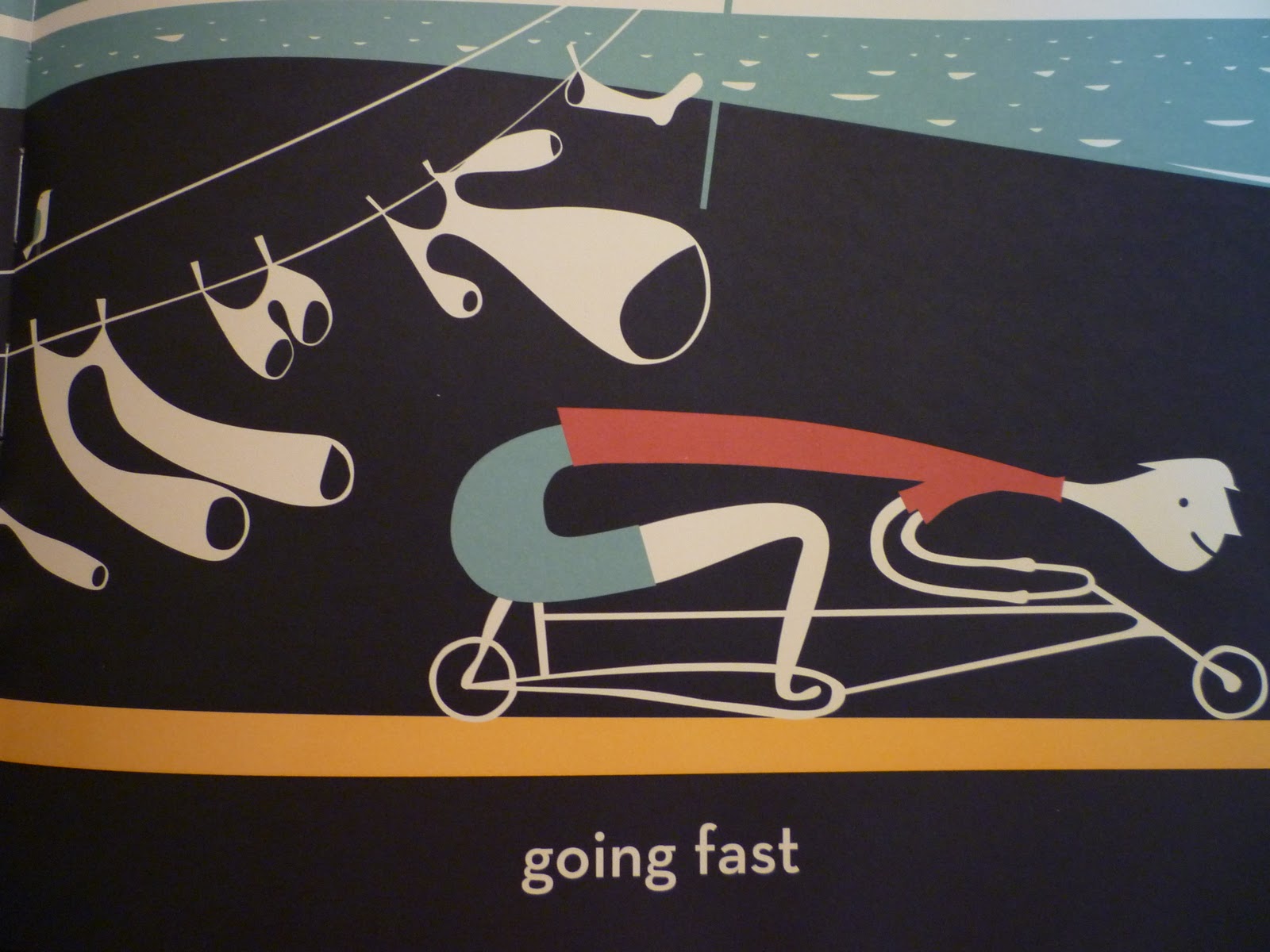
The picture book features stylistic pictures of the long road, made shiny by some plastic coating, and a very long man riding his long and stretchy bicycle. According to the text he rides and rides, “again and again.”

I haven't known small children to be very interested in bicycles. They like their trikes, and boys especially seem to love heavy road equipment, trains, and motorcycles. One more reason to pass on this book.

About the only thing both my husband and I liked was the picture of a pregnant woman whom the cycling man passes. I suppose there are plenty of items along the road that one could talk about with a child, but no story to keep the long road from getting tedious.

I quickly got tired of the man and his weirdly shaped vehicle, expressed in only three colors, plus black. The artwork reminds me a little of an odd and favorite book of ours, The Clock, by Esphyr Slobodkina of the abstract expressionist movement. Slobodkina is better known for her picture book Caps for Sale, but long ago I found a beat-up copy of The Clock, which is a captivating story.

Maybe Along a Long Road would be pleasing to a very early reader, or a delayed reader, who might be able to relate to the sign for lottery tickets or a distant view of a carnival, and who would find satisfaction in reading the words "again and again" again and again. Not that I can imagine a child like that. If anyone out there has had another experience with Viva's arty book, I would like to hear about it, even though I will soon take it back to the library for good. Give me Barton any day.

Limón in the Cazuela

 
The Cazuela That the Farm Maiden Stirred by Samantha R. Vamos is a delightful Hispanic incarnation of The House that Jack Built. It tells the story of a rice pudding from the farm to the table. The reader is introduced to two new words, first in English, every time he turns the page. From then on, those key words are only written in Spanish. 

Before I opened the book, Mr. Glad was enjoying it and noticed that the word for lime was much like our lemon. That made me wonder what the word for lemon is.

A New World Spanish-English Dictionary sits on the reference shelf here as a leftover from the days when four of our children in turn studied Spanish. Even though their father and I never did study that language that is so useful, almost essential, in California, we've lived here our whole lives and have picked up some vocabulary, sometimes by consulting this word book, as I did on this occasion.

The hen helps by grating the limón
I don't know why, but my dictionary is wrong about limón. It says that it means lemon, and that if you want to talk about a lime you say lima. I found it hard to believe that this book written by a woman with a Hispanic name, illustrated by a man with a Hispanic name, with the intent of teaching 21 words, would get any wrong.

But I have a friend who is married to a Mexican man and teaches at a bilingual school, and I couldn't pass up the opportunity to ask my local expert. She wrote, "Okay babe. Limón means lime and limón agria or limón Amarillo can mean lemon. There is a lemon-like fruit called Lima limón. There are not lemons like we have here in the U.S. in Mexico." That seemed a pretty authoritative word on the subject.

This is a picture book, an Easy Reader, so I must not forget to mention the illustrations, which as you can see from these sample pages I photographed are party-bright, full of the joy and fun of cooking together. 

At the back you will find a glossary with pronunciations, in case your Spanish is rusty, and best of all, a recipe for rice pudding. What I would love to do with a young child is read the book, make the pudding together while using the English and Spanish words to talk about the ingredients, and then read the book again while the cazuela simmers.

I would rather one of my grandchildren helped me in the kitchen, while we keep the animals outdoors or in the pages of the book. But an arroz con leche pudding with plenty of crema and some zest of limón would suit me just fine.

Saturday, November 12, 2011

Glorious Mud

Homeschooling Beach Babies enjoy playing in the mud. The sight of these darlings and the memory of my own children in similar settings brought to mind the song I used to sing to them. Nowadays it's easy to find such things on YouTube, which I did.

It turns out what I had gleaned from who-knows-where was only the chorus of a long song titled "The Hippopotamus," by Flanders and Swann, which tune and words form the soundtrack of a suitably watery video.


One can find the words of the verses online, but they aren't really for children. The chorus alone was sufficient to spark up our family's muddy excursions, and it goes like this:

Mud, mud, glorious mud,
Nothing quite like it for cooling the blood.
So follow me, follow,
Down to the hollow,
And there let us wallow
In glorious mud!

Have fun!

Wednesday, November 9, 2011

Hold On! and be saved by grace

Bishop Nikolai

From The Prologue of Ohrid, by St. Nikolai Velimirovich, for today's date:

HOMILY
on saving grace -- By grace ye are saved (Ephesians 2:5, 8).
Who can comprehend and acknowledge that we are saved by grace -- that we are saved by God's grace, and not by our merits and works? Who can comprehend and acknowledge that?
Only he who has comprehended and seen the bottomless pit of death and corruption in which man is engulfed by sin, and has also comprehended and seen the height of honor and glory to which man is raised in the Heavenly Kingdom, in the realm of immortality, in the house of the Living God -- only such a one can comprehend and acknowledge that we are saved by grace.
A child was traveling by night. He stumbled and fell into hole after hole and pit after pit, until he finally fell into a very deep pit from which he could in no way escape by his own power. When the child gave himself over to the hands of fate and thought his end was near, there was suddenly someone standing over the pit, lowering a rope to him and telling him to grab the rope and hold firmly to it. This was the king's son, who then took the child home, bathed him, clothed him and brought him to his court and set him beside himself.
Was this child saved by his own deed? By no means. All he did was to grab the end of the rope, and hold on. By what, then, was the child saved? By the mercy of the king's son. In God's relationship with men, this mercy is called grace. By grace ye are saved. The Apostle Paul repeats these words twice in a short span, that the faithful might recognize and remember them.

Brethren, let us comprehend and remember that we are saved through grace by the Lord Jesus Christ. We were in the jaws of death, but have been given life in the courts of our God.

O Lord Jesus Christ our Savior, by Thee are we saved. To Thee be glory and praise forever. Amen.

Tuesday, November 8, 2011

How to stencil a wood floor?

What it looks like just before you trip

Since we replaced our vinyl floor with wood last year, we've become afraid that one of our guests is going to break an ankle, or worse.

The entry area is raised 6 inches above the rooms on either side, but formerly a metal strip provided a visual cue for most people. Now even friends who have been in our house many times before have missed the step and abruptly stumbled off.

View from the down side
We have wondered why our flooring man didn't anticipate this problem and use a darker wood for the edge of the entry. Oh, well, he didn't. And vaguely Mr. Glad and I have said many times, as when a friend actually fell all the way down, "We should paint that edge with a stencil."

In center: edge that wants marker
But we are not decorators, and have no idea where to start. Wouldn't stenciling a wood floor require some different techniques or materials than the more typical wall stencils? Not that we know anything about that job or have ever had an iota of interest in it, either! This oak floor has two one coat of oil-based sealer and two coats of water-based sealer on it, if that makes a difference.

I know that most women, and many men, have way more experience than I do with decorating, so here I am blegging for any tips and knowledge that any generous soul would like to send my way. It would be nice to get some kind of "safety strip" on there before our houseful of Christmas guests arrives.

Thursday, November 3, 2011

can't say anything good enough


Actually it seems to me that one can hardly say anything either bad enough or good enough about life.  --C.S. Lewis


The Christian life includes both joy and sorrow, and it seems that the intense experience of either aspect can't adequately be described. Each of us has our own unique pain or bliss.

What comes to us on the journey is meant to be shared with and offered to our God; He's the only one who knows our heart, without us saying a word. Christ endured shame, abuse, the Cross, and hell, for the joy that was set before Him. He does know what we are going through, and He went through worse, and the Love in the Holy Trinity is the Sun of which our happiness is only a ray.

Right now I'm walking on the sunny side of life, and I'm glad to say so here, but I won't try to describe my giddiness. I can't say anything good enough about Life. He is the Source, He is the Life, I know that, and I am finding His goodness and kindness in so many things: my husband's love, the warmth of my home, the fatigue from housecleaning, the hope of the tulips I planted blooming in the Spring, the rest at night.

The photo is of a vase that was my grandmother's, with some snippets from my garden. A bit of this and that, a unique medley that reminds me of my blessed life.