Showing posts with label nature. Show all posts

Sunday, March 23, 2014

green and blue coastal views

As I mentioned in my last post, we took a short trip down to California's Central Coast - which we were amused to hear referred to as The North Coast, by those evidently oriented not to the whole state, but to Los Angeles...?

While anticipating the getaway, which was all my dear husband's idea, I started thinking about the edges of the oceans, and how they give us a certain perspective. If you sit or stand on the shore and look seaward, you have all those millions of people behind you, and before you a vastness of water and sky to soothe the eyes and mind, and to make you think. Why don't we all constantly gravitate to the coastlands so that we can be philosophers? It must be because we have so many worthy things we are called to DO.
 
Part of me wants to philosophize in this post, about a score of ideas and realities that are connected in a fascinating way. I could even write a short book for me to read about the ramblings of my mind over the last week, stimulated as it was by books and movies and history and theology that all seemed to relate to our trip.

But I will restrain myself, because I had my time sitting by the shore and now that I'm back inland I need to get on with other things. I won't want to take the time to read that book anyway, so I'll just make this a simple chronological report.


It was at Paso Robles on Hwy 101 that we cut over toward the coast, and the hills began to be greener, with even greener fields of newly-sprouted Something scattered here and there. The farms! Of course we have lots of farms in our county, too, but south of us they grow lots of different things and it does my heart good to see it. Thank you, Lord, for sending the rain to green-up the hills that will soon be golden -- and brown -- again.


Our hotel room in Cambria had a lovely view from the balcony, not just of the ocean, but also of the lush gardens on the property, with some of those favorite plants that I only see when away from home, like proteas and our beloved Pride of Madeira.

Pride of Madeira


The latter is one that we enjoyed many times on wedding anniversary trips we've taken, because it blooms in March. This time I told Mr. Glad that we might consider it "Our Flower."

a protea
town of Cambria from the boardwalk

As soon as we brought in our bags we set off on the boardwalk along the long strand of Moonstone Beach, which appears to have a population of thousands of ground squirrels living under it. They popped up on one side or another every few feet to say hello and beg demurely.

Many benches sit along the boardwalk, too, providing places for philosophers to gaze out at the great beyond. Some had extra, very personalized signs and plaques, screwed into them.


Down below we scrambled on the rocks and found crabs and snails and seaweed in the cracks and tidepools.

All the salt water stands in stark contrast to the drought that is especially bad on the California coast. At our very nice restaurant in Cambria they charged us for water with dinner! Just 30 cents for a bottle, but enough to draw attention to the problem and prevent the waste of all those glasses of water that diners might ignore.

When we left Cambria we drove south and stopped near the town of Harmony to try out the Harmony Headlands trail that cuts through a swath of farmland to link up with coastal bluffs. We could smell the sagey-beachy scent that let us know the ocean was just over the hill, but we never seemed to be reaching a place from which to get even a distant view of it, so we eventually gave up and turned back. On the way back to the car this snake slithered off the edge of the trail. When I followed him into the field he froze and posed.


Neither of us had ever been to the town of Cayucos, which was our next stop. We liked this place a lot, with its casual and less touristy flavor. It used to be a shipping hub in the late 1800's, and it's close enough to San Luis Opbispo and the college of "Cal Poly" that there were lots of students in town, and surfers to watch as we relaxed on the sand near the old pier.

Cayucos from the pier

At one end of the beach a woman drew in the sand with her foot, to draw attention to a seal pup that was lying like a lump near the shore. I did think it was a lumpy rock, until I saw her circle.

She was also standing guard against dogs who had been bothering the animal that she said was malnourished and waiting for the marine mammal rescue people to come. When a group of school children approached, the pup lifted its head long enough for me to snap a picture.

blue ceanothus, cistus, and CA poppies


Later in the week on our way home I got in more close-up views of some favorite Spring-y color combinations -- at a highway rest area!

My tangible souvenirs were three, two rocks and a piece of sea glass, my material Gifts From the Sea. As to non-material and most valuable things gained....I'll be meditating a long time on that realm of Beauty.

Monday, March 17, 2014

The Tide in the River

A short verse stuck in my mind over 20 years ago, and has been playing there off and on out of a proper context. I'm pretty sure it came to me in a book of poems for children, and somewhere along the way I incorrectly connected it with Longfellow; when recently I searched around online for a while I found that the author is Eleanor Farjeon.

Only once that I can remember did the meaning fit with the situation, when I was with my dear husband on a short getaway to celebrate our wedding anniversary. We were staying in the company town of Scotia in way-northern California, where the sawmill is built near the Eel River.

After dinner we walked in the dark around the village of Rio Dell close by, and on our way back to the hotel stopped on the bridge to lean over the rail; we listened to the quiet flowing noise and could barely make out the stream down below. Here was the right time and place, and the verse very nimbly popped into my mind, and I recited:
The tide in the river,
The tide in the river runs deep.
I saw a shiver
Pass over the river
As the tide turned in its sleep.
         --Eleanor Farejon
Now we're celebrating that blessed day once more, but we're driving to California's Central Coast this time for our little vacation, to the town of Cambria where we spent part of our honeymoon and which we haven't visited since. Maybe we'll go to the beach this time. Let me see, do I know any beach-y verse I could get ready?

Friday, March 14, 2014

a breathing


The End of Sleep

The eyes are about to open.
Through fog, Sleep crosses the great water—
See how it sails in the little boat?
Slowly, such a long journey,
Bits of light
Catch colors in the mirrored hull.
Beneath the glassy surface, a glimpse
Of your dreams: the lake, the boat, with you
In it. Now a shadow
Falls over you: above the surface,
The figure of Sleep
Has leaned over its boat.
Hear Sleep's feet plop in the shallows—
It pulls the boat to shore.

      -- Elizabeth Twiddy
This morning as I neared the shore of full consciousness, what I saw through the fog was myself, getting dressed and going to church for a Presanctified Liturgy. I was full of happy anticipation. Then I pulled the blinds open and was surprised to see, not the sunny and warm skies of the last few days, but thick and cold white fog.

I've read many people who say they love the fog, and I thought of them right away, wondering why I couldn't be like them. Then I remembered the foggy days of my childhood when in the winter the damp cold would settle over California's Central Valley like a perverse blanket. Not your normal blanket that makes you cozy, but something more like a conduit of chill. My fifth-grade teacher Mrs. Wicks, who came from South Dakota, said she was never so miserable in the dry winters of her youth as she was in our "temperate" weather that froze her to the bone.

The natural and normal tule fog that emerges from the ground after the first winter rains became a dangerous foe once I learned to drive and became aware of all the car crashes on the highways that are a frequent accompaniment to the season. I became familiar with the stiff neck you get peering intently through the wall of white trying not to run into something.

But this morning in March, all of that is far behind me, and for the Valley-dwellers it is likely passed as well by this time of year. So I thought I would look for a poem by one of those fog-lovers. The fog that's outside my window is still a little too cold for my old bones to thoroughly enjoy, but I'm working on it. After all, it's another part of our earthly home that is filled with the breath of God.
The Breathing

An absolute
patience.
Trees stand
up to their knees in
fog. The fog
slowly flows
uphill.
White
cobwebs, the grass
leaning where deer
have looked for apples.
The woods
from brook to where
the top of the hill looks
over the fog send up
not one bird.
So absolute, it is
no other than
happiness itself, a breathing
too quiet to hear.

    ~ Denise Levertov

Thursday, February 27, 2014

a little dancing sister


...Nature is not our mother: Nature is our sister. We can be proud of her beauty, since we have the same father; but she has no authority over us; we have to admire, but not to imitate. This gives to the typically Christian pleasure in this earth a strange touch of lightness that is almost frivolity. Nature was a solemn mother to the worshipers of Isis and Cybele. Nature was a solemn mother to Wordsworth or to Emerson. But Nature is not solemn to Francis of Assisi or to George Herbert. To St. Francis, Nature is a sister, and even a younger sister: a little, dancing sister, to be laughed at as well as loved.
        ― G.K. Chesterton, Orthodoxy
I've been enjoying my little sister in the garden this week. It started with a long weeding session, during which I rescued the sweet peas from a weed of which I don't know the name. Does one of you know it?

 
It's been growing taller than the peas, and even though I made some nice trellising for them, they have been confused by these weeds and are trying to climb on them instead.

The green and trailing weed is also flowering before the sweet peas bloom, and is not in any way an unpleasant weed to deal with.
  
How about this weed? Maybe someone can tell me its real name. We call it The Scattery Weed, because before the seeds are obviously ripe, when the plant still looks small and innocent, it waits with secret menace for the gardener to stroll by and brush it with her shoe or hand, then !!explosion!! of seeds in a several-foot radius.

I probably shouldn't use the word menace when talking about my little sister. In this case she is only doing what is in her nature, and doing a good job of bearing many children for next year's springtime.


I found more signs of spring while I was out there, like this oxalis blooming among the violets...


...plum blossoms decorating violets, and the violets springing up tall to decorate an irrigation head.


Above is a field of manzanita blossoms fallen from the bush to make way for berries, and hanging over them are snowdrops, truly looking like little sisters dancing in their pretty spring petticoats.

I finished my garden work just ahead of the steady rain we've been getting today. God is watering the earth and sending His rain "on the just and the unjust." Thank You, Lord!


Linking up to Weekends With Chesterton.


Sunday, February 16, 2014

RFC considers blood and sacrifice.

I owe you something more, however -- something darker -- on the subject of meat: The minor leads inexorably to the monumental. Lamb has set our feet in a large room indeed. Man not only dines: he also kills and sacrifices. The room in which he relishes the animal orders lies between slaughterhouse and temple. There are death's heads at each end of the table of the world.
In The Supper of the Lamb: A Culinary Reflection Robert Farrar Capon introduces what is perhaps the most poetic chapter with this paragraph. He explores our human proclivity to hunting and butchering and the Jewish temple sacrifices in a long poem that I mostly didn't have the patience for, though I liked its division into sections named for the categories of the car game:
Animal, Vegetable, Mineral;
Testing the textures of creation,
     savoring the styles of its coinherence.
After describing the neat and clean Mineral parts of our world, he moves on to the Vegetable, "the kingdom of seed, birth, life....And for the first time,/ the reek of death." But

Onions die quietly,
Cabbages shed no blood;
All plants forgive:
By the waters that comprise them
They wash man's hands
And let him walk away.
Eating vegetables is so innocent. But Capon doesn't want to ignore the reality of our place as carnivores, so he unapologetically moves on to the Animal kingdom
each man owning the honest interchange by which he steals his livelihood; each woman's hand intimate with the crack of wrung neck and severed spine....
It is not possible or even desirable to distill the writer's poem into a fully satisfying theology, but I wanted my readers to know that he does satisfy himself with the mysteries of God's plan of salvation, of which the temple sacrifices were a foreshadowing of Christ's sacrifice on the cross.
The world awaits
The unimaginable union
By which the Lion lifts Himself Lamb slain
And, Priest and Victim,
Brings
The City
Home.


Other posts in this series are:
RFC is the man we need.
RFC begins with the meat.

Thursday, February 13, 2014

wintertime loves


We in the arid parts of the West have been exulting in rain the last week or so. It's so comforting and even glorious to wake in the night and hear the rain still coming down. Then to wake in the morning and see it is still falling. We had puddles in the back yard! Thank you, Lord!

Mr. Glad and I do live in northern California, but daughter Pippin lives even farther north in the state, and we drove there early this week for a short visit. Often February is a very snowy month at her place, but this year they've had more dry weather and rain than snow, and even the rain stopped while we were there, so we could get outdoors easily for work and recreation.


One day we made a family project out of pruning old apple trees that Pippin and The Professor are trying to revive from years of neglect. I floated back and forth between lopping branches and swinging the kids.


I would get Scout and Ivy going and then run over to take a picture of the adults on ladders.


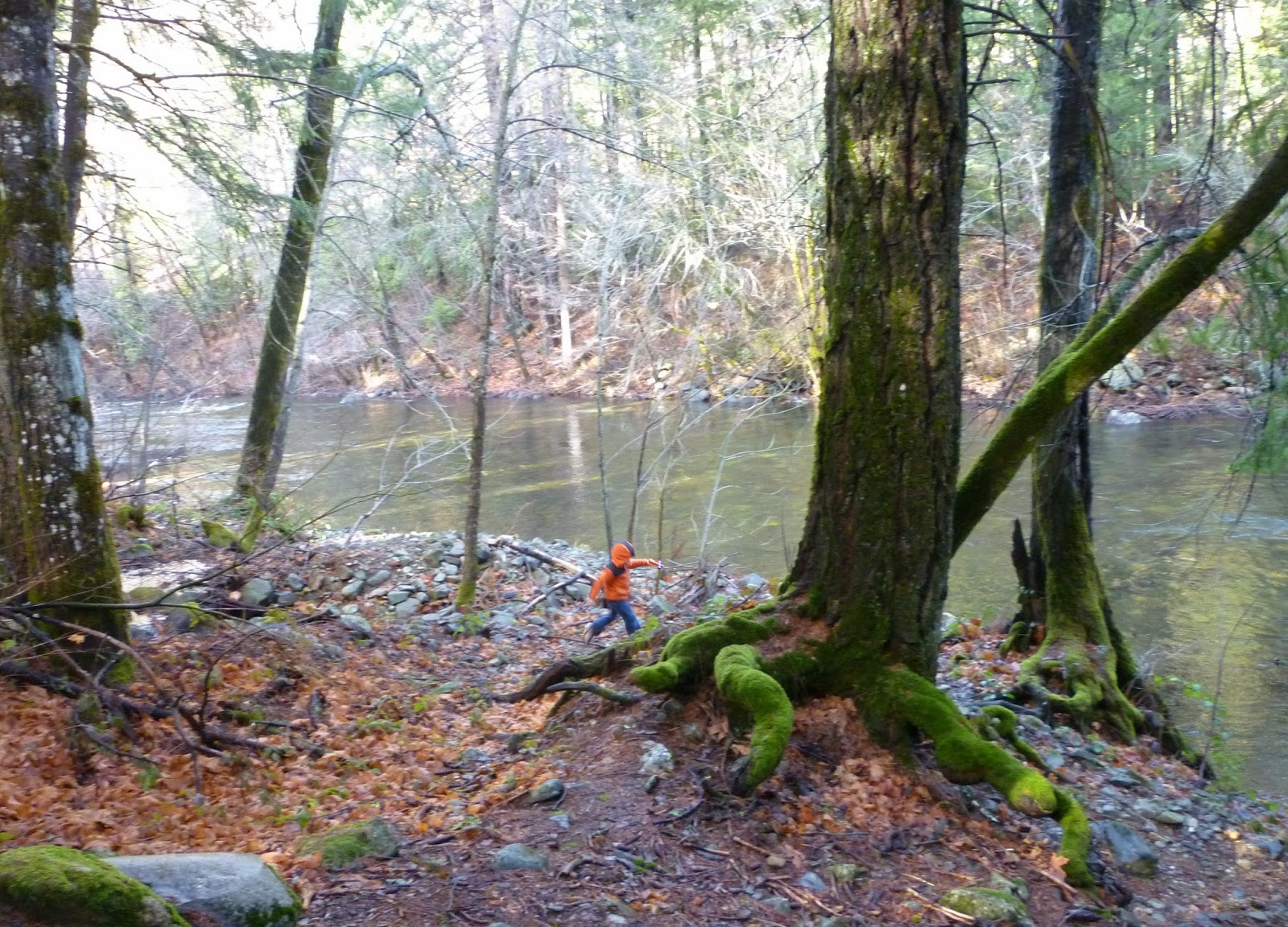
Another day we took a short trip to Castle Crags State Park and walked a trail alongside the Sacramento River. Considering the dryness of this year, I was amazed at the thick moss and ferns.


Port Orford Cedars like to grow next to rivers.
  
A pale green, almost white lichen grew on rocks and tree stumps.

yew trees on the riverbank
Grandson in orange jacket


Everything was wet from the recent rains, and many times our feet slipped on the invisible mosses -- or was it algae? -- growing on wooden bridges or river rocks.


Ivy practiced throwing pebbles into the river, and once she got the hang of it she did not want to do anything else. The supply of rocks was endless.

We went to the confluence of Castle Creek (in the foreground below) and the Sacramento River, from which you can get great views of the jagged rocks above, called the Castle Crags. They are high enough that the recent precipitation there was in the form of snow, and some was still unmelted and visible.


My dear husband showed me this large and artsy rock, which you can also see in the photo at the very top of this post, in its original setting. I wanted to take it home. It was a little too heavy for me to carry, so The Professor hauled it back to the car. It came with us on our journey home and is now living by our house. Mr. Glad classified it as a confluitic rock.

Winter days are short enough that at the end of our busy days there was plenty of time for cozy gatherings in the kitchen or by the wood stove. I read many books to the children. Scout's current favorite, which I read about on a blog before Christmas and gave to him, is Bumblebee at Apple Tree Lane, and we read it several times. Ivy likes The Little Fur Family best right now.

We danced to the children's favorite recordings, and also listened to bird calls on the Stokes Field Guide to Bird Songs CD. After ten minutes of loons and other waterfowl, Ivy must have deduced that those bird songs were some kind of dance music, too, and she started twisting and prancing around.

Hot soup is what you need on a winter's night, so Pippin and I learned how to make French Onion Soup, using the recipe in The New Best Recipe: All-New Edition by Cook's Illustrated Magazine. The secret that the Cook's testers learned is that red onions give the best flavor. Our result was sooo good.

And cookies! Pippin had some dough left in the freezer from her Christmas Peppernuts, the recipe that I concocted a long time ago but haven't made for years. We like our nuts to be nut-sized, so we always cut the frozen dough into little cubes and bake them long enough that they come out crispy. Next Christmas I'll give the recipe.

But for now, since I do love cookies, they make a good ending to my story 
of a wintry family visit that was warm and sweet.