Sunday, May 26, 2013

May the pots never grow cold.

About 30 years ago we owned a modular house whose many large windows were covered by the original fancy draperies, so that when the curtains were closed they covered most of the expanse of three walls with nubby gold curves. The walls were thin particle board painted to look like wood, as you can see in the photo - but I didn't mind those as much as the drapes. I would have preferred something more rustic and casual and of another color to go with the country setting, but even if we'd had the money we couldn't have justified spending it to replace Perfectly Good high-quality drapes.

It was a recurring temptation to me, though, to stew over how ugly and Not Me they were. This was tiresome, and eventually my better self convinced my offended self to stop, using this argument:

What is your purpose in life? To love God and be useful to Him.

What is the most important way for you to do that? To love people.

Do you need pretty and tasteful drapes in order to love people? No, I answered. If someone who comes to my house sees my drapes and not me, I can't help that. If they need my hospitality and friendship they need it from me personally, and God will just have to use me in spite of this ugliness in the room. (Which of course was not a universally recognized ugliness anyway.)

Those of us who have read any of Edith Schaeffer's other books know that she by her life and words demonstrated the importance of love and hospitality. Her book The Hidden Art of Homemaking, which is the subject of a book club hosted at Ordo Amoris, I do not take as contrary to the rest of her life and work, but complementary to it. Some of you may not have read the other books like What is a Family? Partly from reading it I am pretty sure that if she had to choose, she would herself rather have been a resident or guest in a plain and even ugly house run by a warmhearted woman than in an artistically decorated dwelling with an unkind or angry soul. We've all heard of and perhaps had the experience of going into a house where the decor was shabby or messy but you wanted to be there because it felt like home -- welcoming and nurturing. Mother Teresa's saying fits here: "Love begins at home, and it is not how much we do... but how much love we put in that action."

I think Edith's own houses were like this, because she was that kind of woman, and likely much more than I myself am. But I have it as a vision to be like that, and am inspired by quotes that speak of a woman being able to make a home wherever she finds herself, of a woman herself being the heart of her home....but I can't find any of those at the moment. The line that has intrigued me for years now is from the Santana song "You've Got to Change Your Evil Ways," from the perspective of a man who is dismayed by his woman who's gadding about all the time:
When I come home, Baby,
My house is dark and my pots are cold.
These are just signs to the poet that there is no woman at home to welcome him.  The verse reminds me of advice I read to housewives who haven't figured out what to make for dinner, but who want to do something to give their husbands a good feeling when they come in the door after work: While you are getting your act together put an onion in the oven to bake so that he will get a hopeful olfactory signal.

A message I get here: A woman conveys her love and hospitality by these simple modifications to the environment: opening the drapes or turning on the lights, cooking something in the kitchen, and in both ways warming up the sensory atmosphere. If she has a kiss and a smile for her family and guests all the better.

The last few years when my husband and I live here alone, I notice that I am the one who thinks about light control. In that photo above you can see all the light that came into the humble house with the gold drapes. It was the best feature of the house, as I was later to discover, when I wanted our new house to have as much light -- it was not to be. The photo was likely taken in the winter, when we would open the drapes wide and let in all the warming sun.

In our area we can get along pretty well in summertime without air conditioning, if we manage the windows and window coverings: At night open all the windows to let the cool air in; in the morning close everything up to shut out the sun's rays, and leave them that way (and the house kind of dark!) until the air inside gets as warm as outdoors -- then you may as well get any breeze that might stir, and be ready for the coolness to enter as soon as it arrives.

In Spring or Fall our present house doesn't get very hot, so in the mornings I like to open the blinds and let the sun in as soon as I come downstairs -- but my man never thinks of doing this. For my mind, sunlight is the very loveliest decoration. And at night, I like to close the curtains or blinds so as to feel sheltered against the world. This also seems to be, in my experience, a homemaker's impulse.

I have learned to do many artful things in my houses over the decades; I have arranged and painted furniture, swept the floor, bought bedspreads and embroidered Bible verses to hang on walls that I painted, but those things aren't more important than the light-monitoring I do. I also tend the fire in the stove, and light candles, and keep the pots warm.

While you're working on the outward appearance of your home, attend also to your heart and keep it warm with prayer. If the family members are getting snappy or sulky, take a prayer break together and ask God's help - then sing something to warm up the atmosphere. I like this quote that Debbie posted, by Laura Ingalls Wilder:
Let's be cheerful! We have no more right to steal the brightness out of the day for our own family than we have to steal the purse of a stranger. Let us be as careful that our homes are furnished with pleasant & happy thoughts as we are that the rugs are the right color and texture and the furniture comfortable and beautiful.
Thank God for making Edith Schaeffer the kind of woman who could pass on to us a bright homemaking heritage.

Friday, May 24, 2013

The parasitic snow plants are blazing at Tahoe.

Mr. and Mrs. C. invited us to their cabin again on the south end of Lake Tahoe. At 6,000 ft. elevation it's still pretty brisk in May, but the sky was SO blue, the lake was SO blue, and the air was dry, full of the smells of pine trees and cedars with some wood smoke thrown in. I breathed deeply.

Here is a map if you need to get your bearings. The lake itself lies on the Nevada-California state line. We usually approach from the southwest and drive through the state capital of Sacramento to get there.


I had escaped the world down below where picture storage was one of the many time-consuming computer problems that had recently worn me out, and I arrived with a reluctance to use my camera. Of course that didn't last long, especially when wildflowers are out. May in the Sierras brings flowers you can't see in the summertime, so I had to seize my opportunity, didn't I? My other blog posts about the Tahoe area have different photos from what I came away with this time.

Cascade Lake in foreground, Tahoe in distance.


We hiked to the top of Cascade Falls one day. It drops and flows into Cascade Lake which lies just south of Emerald Bay, a little higher in elevation. This picture was taken from a granite shelf looking as straight-down as I could manage to the bottom of the falls.
Sticky Cinqefoil
                      This looks to me like some kind of buttercup but I haven't found it in a book yet. (Update: I added the caption after one of my readers enlightened me.)


The Snow Plants have popped up all over, here and there on the floor of the conifer forest, with no leaves. Mrs. C. was coveting one, wondering how she might get a specimen to grow near the cabin, but what I found out on Wikipedia when I came home makes me think that would be near impossible to make happen.


The snow plant is sarcodes sanguinea, the only species in the genus sarcodes, in the heath family. It is unable to photosynthesize its own food, "...a parasitic plant that derives sustenance and nutrients from mycorrhizal fungi that attach to roots of trees." Now I can imagine the roots of these bright plants extending deeply into the world of tree roots. If we are lucky, perhaps the right conditions will in the future concur and surprise Mrs. C. with a burst of red.


A lagoon by Kiva Beach

Another color that got my attention was the sand around Lake Tahoe. We took the yellow lab to swim and fetch and I sat on the shore and considered how all the grains of sand were warm golden tones, not like any ocean beach I've seen.


 Wooly Mule's Ears, also known as mountain mule's ears, were in bloom, and I got a photo of them as in a perennial bed planted by Mother Nature, with a border of Squaw Carpet in front.

Wyethia mollis and Ceanothus prostratus


Here's a nice flowering bush that I don't know. Maybe someone reading this knows this plant? It grows in the forests on public land and in private yards. (Update: the same reader in a comment below is kind enough to tell us that this is Western Serviceberry.)


Did you ever do a Google image search of "lichen"? Amazing, amazing plants. Here is one of the more subtle designs, which we saw on a rock at the top of Cascade Falls, a lovely arrangement of vegetable and mineral and just one example of how God's artwork is splashed all around the world for our pleasure and His glory. Thank You, Lord, for the refreshment.

Thursday, May 23, 2013

I did it for love of manzanita.

I am reposting this story from two years ago for the Hidden Art of Homemaking discussion at Ordo Amoris. It's about one of my projects that illustrates some of the difficulties and satisfaction of interior decorating.
 
A botanical theme has emerged.

Decorating is a homemaking job that I wish I could get over and done with and on to other things. This post is about how the realization of that wish is a long time coming. On one level the story bores me to death, even though it's my own house I'm writing about, the house I've been investing in for 20 years. That should warn most of my readers to leave right now and go read something more entertaining.

What's makes me want to tell this too-long tale anyway is the way it illustrates how an incredible amount of mental and physical labor can go into what seems a simple project. I suppose I'm not used to this precisely because I'm not into home decorating and haven't applied my perfectionistic creative energies to it so much before. In a way it's a larger-scale version of my doll clothes effort: what I envision doesn't come in a kit.

If I could make a kit out of it no one would buy it. It's just the best that we could do given our priorities, and with a tract house that doesn't have enough walls to be cozy or enough windows to brighten the view. The story I tell is also amusing if one considers the output of my mental energies compared to the mediocrity of the results.

G.K. Chesterton said,
It is the main earthly business of a human being to make his home, and the immediate surroundings of his home, as symbolic and significant to his own imagination as he can. 
I'm not sure what all G.K. meant by that, but he does seem to give me liberty, and even to tell me it is my duty, to spend time on my house and property with the purely physical and aesthetic aspects in mind.

One year ago
So, I push on. Last year we changed the arrangement of the living room furniture so that the pictures on the wall didn't work anymore. It seemed that the painting that used to be above a couch was too "heavy" after we moved the piano under it. It was then the largest wall item above the largest piece of furniture. Also, the TV had come out of the closet and found a new and permanent place in a corner, and the emptiness above it bothered me for months while I tried to figure out what to put there.

The first thing that came to mind was a manzanita branch such as I remembered my grandmother having in her living room for a while, a natural curio of sorts. Hers had sat on the coffee table, I think, but mine would hang above the TV to fill some of that airspace and balance out the piano nearby. (We'd need to get a smaller something to put above the piano, too.)

I started looking online for manzanita, but I found only small and twiggy, pale specimens, for use in flower arrangements. So I gave up for a while and spent hours looking for a decorative mobile. Nothing pleased. By that time we were in the middle of the remodel, so it wasn't urgent.

Then in April we went north to Pippin's place, where the previous winter's record-breaking amounts of snow had piled up everywhere. As we walked through her forest we saw several manzanita bushes with large branches broken off. My mind started twirling around the idea that I could prepare my own decorative branch. The others helped me choose a couple that might work and we hauled them home.

Nine months ago
I still didn't know if I could accomplish what I envisioned; I've never been one to do woodworking of any sort. I knew enough to trim off the flowers and small twigs. Then it occurred to me that wood needs to dry out before one can work it. I read that manzanita tends to split, so people have trouble making furniture out of it. Maybe my branches would split too much as they dried?

I left them sitting around in the garage for a couple of months and they only split a little bit. On the Internet I read somewhere to paint them with Danish oil to preserve the wood, so I did that. And one of my children said I should stain the trimmed ends of the branch so the whiteness of the wood wouldn't distract from the lovely smooth and dark bark.
I think this is the one I didn't use.

It was B.'s upcoming birthday party that put the fire under me to get the chosen branch up in the corner. We bravely screwed two hooks into the smooth new ceiling, and I painted them white so they would fade into the background. Then three strands of fishing line were tied to those, and to the branch.

Soldier was here and helped me position it just so; he's tall and strong and could stand there calmly holding it in midair while I fumbled with the almost invisible threads. Then voilĂ ! At last, that one part of my decor was in place (now we only had to ignore the empty space above the piano) and all our party guests could admire it. I began brainstorming on a solution to that remaining space nearby.

Three weeks later I dusted the manzanita with a feather duster and the next morning it crashed onto the TV and to the floor. Nothing was harmed. Guess we needed stronger filament. It took me about two months to get to the store to buy it. Then it took another month before B. and I could make ourselves re-hang the branch. See what kind of do-it-yourself-ers we aren't?

I was sure I knew how to orient the branch, the way Pippin had told me to, but after B. and I got it centered and hung and he'd gone bike-riding, I realized by looking at previous photos that I had it exactly backwards, and it truly didn't look the best. I tried just flipping it over, and that sort of worked; I only had to re-tie one filament, and we were o.k....except that now the branch was a little closer to the ceiling than ideal, and the top of it was vaguely lined up with the curtain rod, which didn't look right. I suffered with that all through Christmas, trying not to care. Of course most people said it was fine because no one wanted to go through the difficulty of doing it over.

I had to buy a piano lamp before I could decide what would go behind it; our old one was shot. Piano lamps are expensive! The cheapest one I could settle on was out of stock for a few weeks, so we waited on that. I had looked at so many paintings or other wall decorations, many hours of browsing over several months, and found nothing I wanted enough to spend money on.

So I thought I would saw and paint some wooden birds to hang up there...they needed to be warm and colorful, because the corner with a black TV and a stark naked branch turned out surprisingly modern and chilly. (Maybe what I need is a branch about five times that big, just sitting on the floor behind the TV and reaching toward the ceiling...and permanently trimmed with Christmas ornaments...? )

But then we must return to how I'm not a woodworker, or a painter for that matter. I think it was on New Year's Day that I felt desperate to make some progress; I decided to spend money and get something. B. and I knew we needed color there, and we knew the parameters of what the measurements needed to be. I bookmarked some paintings, and when B. came home from watching a football game we chose one and ordered it. Whoopee!

The painting arrived and sat on the floor near its destination for over a week. I knew we needed to be in the right mood to even talk about putting it up. In the meantime, one day I got a burst of courage and all by myself re-did the lines supporting my manzanita. I think it might be as much as an inch lower. A most satisfying inch.

Last week we hung the picture. Those are giant poppies providing the splash of color. I hope Mr. Chesterton is happy and won't mind if I get back to my sewing and reading now.

Friday, May 17, 2013

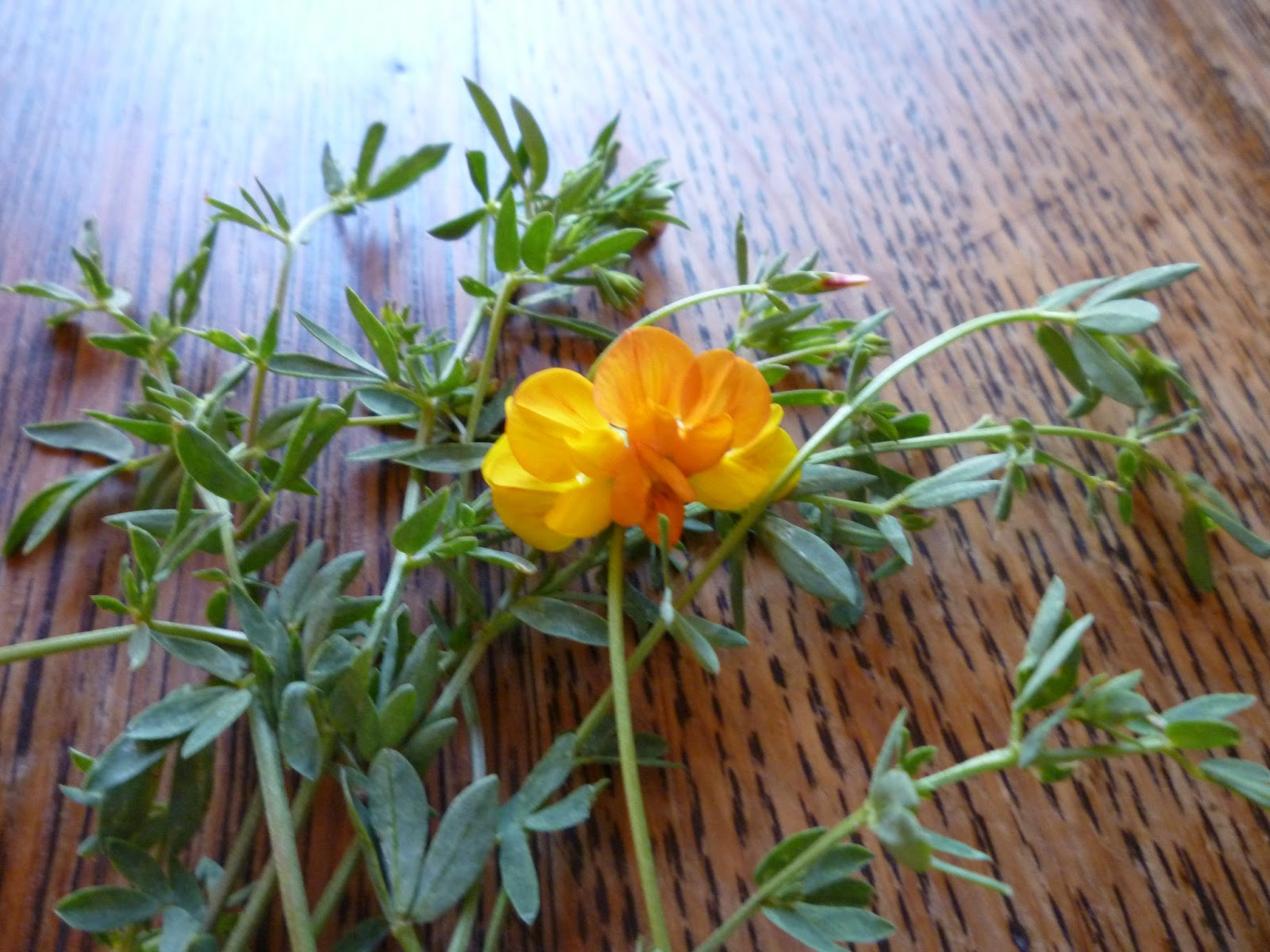
I might have found a lotus.

Recently on a walk through the neighborhood I noticed a pretty little weed flower by the path, and remembered having photographed something like it in the past. A few minutes after returning to my computer I saw Nature I.D.'s blog post "lots o' lotuses," and the pictures looked so much like the plants I had just seen. Here's one of Katie's photos:


Today Mr. Glad and I were out in a different part of the neighborhood, and there was my flower growing in a sidewalk crack. I grabbed a bunch and brought it home. Here is its picture. I don't have time to research this thoroughly right now but I'm putting up my pictures for Katie and anyone else interested to see. They are cute little flowers in any case and a welcome break from ugly thistles and puncture vines.

It just occurred to me that it would be fun to document all the weeds that grow through the different seasons around here, when they catch my attention. But I also thought of doing a similar project in my own yard, with the beloved plants that I cultivate. And the latter sounds like more fun for a starter.


Thursday, May 16, 2013

Stages of Flowers


This evening I brought in a few stems of Cécile Brunner roses to decorate my windowsill. I notice that a couple of the roses have buds sprouting from the center of the flower, and I don't think I've seen that phenomenon before.


Actually, this one seems to have two buds coming out.

My godmother is collecting rose petals for throwing at some point in her daughter's upcoming wedding. As I have to be out of town and will miss the event, it made me happy to be able to contribute some petals, which I acquired by picking spent blooms from another friend's prodigiously blooming bushes. It took me about a half hour to collect a couple of grocery bags full, and another hour to sift through and take out insects and stems. I set them to drying in an ice chest and a big tub, and while they sat in the sun the remainder of bugs seem to have departed. A few times a day I am stirring them.


The Patty's Plum poppy that Pearl gave me years ago has three blooms this year! I may have already put up a photo of one. But this third flower is the prettiest yet. The plants stand about a yard tall.


Kate sent me a pot of Lily of the Valley bulbs for Mother's Day. Less than a week later they are already a couple of inches high. I have Miss Grenadine keeping me company on the windowsill above the sink these days; she can help keep an eye on the shoots.

All over the garden I've been digging holes and putting in various other flowers: zinnias, mimulus, mixed colors of California poppies, African daisies, lobelia, morning glory. In a few weeks I should have more flowery pictures to show. I've been putting my tools away every night and have swept the patio. Everything is ready for you to come and visit my garden!

Tuesday, May 14, 2013

We rejoice with the dead and scatter eggshells.


Grave with exuberant rockrose
Today is Radonitsa or The Day of Rejoicing, Tuesday of Thomas Week in the Russian tradition, though some Orthodox churches visit graves on Thomas Sunday. My parish doesn't have a churchyard (yet) so we don't have a gathering in the church with traditional foods, as is the Old-world custom. But several of us joined nuns from the nearby skete at a cemetery not far away and sang a service of remembrance, alternating with joyful Easter hymns. It was a warm day on a dry hill; the sun was toasting the weeds underfoot and making them smell like cookies in the oven.

The Resurrection icon at top shows several elements that signify the ramifications of Christ's rising from the dead, and every version shows in the center Christ pulling Adam and Eve from their tombs, from Hades. David and Solomon and Abel and John the Baptist and others are featured - we all are raised with Christ, as the church books explain:
Having previously celebrated the radiant feast of Christ's glorious Resurrection, the faithful commemorate the dead today with the pious intent to share the great joy of this Pascha feast with those who have departed this life in the hope of their own resurrection.
This is the same blessed joy with which the dead heard our Lord announce His victory over death when He descended into Hades, thus leading forth by the hand the righteous souls of the Old Covenant into Paradise. This is the same unhoped-for joy the Holy Myrrhbearing Women experienced when discovering the empty tomb and the undisturbed grave clothes. In addition, this is the same bright joy the Holy Apostles encountered in the Upper Room where Christ appeared though the doors were closed. In short, this feast is a kindred joy, to celebrate the luminous Resurrection with our Orthodox forefathers who have fallen asleep.


My own parish comes out of a Russian tradition (though we are presently mostly Americans without Russian ancestry, and part of The Orthodox Church in America.) So we keep this day, which even St. John Chrysostom mentions in the 4th century. After the short service we all walked around scattering eggshells on graves and calling those who have fallen asleep, "Christ is risen!"

The Theology of Beauty

I'm re-posting this part of book review from 2012 as a contribution to the discussion of The Hidden Art of Homemaking on the Ordo Amoris blog.

Possessing Beauty

No changing of place at a hundred miles an hour will make us the one whit stronger, happier, or wiser. There was always more in the world than men could see, walked they ever so slowly; they will see it no better for going fast. The really precious things  are thought and sight, not pace. It does a bullet no good to go fast, and a man, if he be truly a man, no harm to go slow; for his glory is not at all in going, but in being.
      --John Ruskin, quoted in The Art of Travel by Alain de Botton

John Ruskin
Ruskin is one of the "guides" the author takes as a teacher in his study of this art of travel; this particular guide yearns to give us his students the tools to understand and possess beauty. Ruskin believed that we can only understand beauty by paying close attention to it, and that attempting to describe nature through writing or drawing was the surest way to focus the mind sharply enough.

On the topic of drawing Ruskin published two books in the 1850's and gave lectures in London, but the point of his instruction was never to produce students who could draw well. He wanted to teach people to notice, and to "direct people's attention accurately to the beauty of God's work in the material universe."

Right here is a good place to propose that we who believe in God the Creator also take as our teacher John Ruskin, rather than Mr. de Botton, because I doubt that we can learn much directly on the subject of beauty, especially on how to possess it, from a man who doesn't understand that beauty, and in fact all that he possesses, are gifts from his Father God.

De Botton's most recent book is Religion for Atheists, which he wrote from the conviction that a disbelief in God should not prevent atheists such as himself from making use of various aspects of the major world religions to better their lives. No doubt many professing Christians have a similar pragmatic outlook, and are missing out on the essence of the faith, Who is Christ Himself, the Bread of Life, the Glory of God the Father.

In musing about the beauty of God, I came upon a website with that title, featuring quotes from Jonathan Edwards. Many people have caught a bad impression of Edwards from those who speak of what they know not, but long ago I learned that the most frequent word in the preacher's sermons was "sweet," in reference to God and fellowship with Him. It's not surprising that he had something to say about beauty as well. (The following paragraphs from Edwards were taken from his writings "The Mind" and "True Virtue" and bundled on the webpage with the added headings.)

God is Beautiful: "For as God is infinitely the greatest Being, so he is allowed to be infinitely the most beautiful and excellent; and all the beauty to be found throughout the whole creation, is but the reflection of the diffused beams of that Being who hath an infinite fulness of brightness and glory."


Jonathan Edwards
Beauty is a kind of consent or harmony: "[Beauty is] a mutual consent and agreement of different things, in form, manner, quantity and visible end or design; called by the various names of regularity, order, uniformity, symmetry, proportion, harmony, &c. . ."

“One alone, without any reference to any more, cannot be excellent; for in such case there can be no manner of relation no way, and therefore no such thing as Consent. Indeed what we call One, may be excellent because of a consent of parts, or some consent of those in that being, that are distinguished into a plurality in some way or other. But in a being that is absolutely without any plurality, there cannot be Excellency, for there can be no such thing as consent or agreement.”

Love is the highest kind of beauty: “The reason, or at least one reason, why God has made this kind of mutual agreement of things beautiful and grateful to those intelligent beings that perceive it, probably is, that there is in it some image of the true, spiritual, original beauty, which has been spoken of; consisting in being’s consent to being, or the union of spiritual beings in a mutual propensity and affection of heart. . . . And so [God] has constituted the external world in analogy to the spiritual world in numberless instances. . . . [He] makes an agreement of different things, in their form, manner, measure, &c. to appear beautiful, because here is some image of an higher kind of agreement and consent of spiritual beings.”

“When we spake of Excellence in Bodies, we were obliged to borrow the word Consent, from Spiritual things; but Excellence in and among Spirits is, in its prime and proper sense, Being’s consent to Being. There is no other proper consent but that of Minds, even of their Will; which, when it is of Minds towards Minds, it is Love, and when of Minds towards other things, it is Choice. Wherefore all the Primary and Original beauty or excellence, that is among Minds, is Love.”
God is beautiful because He is a Trinity: “As to God’s Excellence, it is evident it consists in the Love of himself; for he was as excellent before he created the Universe, as he is now. But if the Excellence of Spirits consists in their disposition and action, God could be excellent no other way at that time; for all the exertions of himself were towards himself. But he exerts himself towards himself, no other way, than in infinitely loving and delighting in himself; in the mutual love of the Father and the Son. This makes the Third, the Personal Holy Spirit, or the Holiness of God, which is his infinite Beauty; and this is God’s Infinite Consent to Being in general. And his love to the creature is his excellence, or the communication of himself, his complacency in them, according as they partake of more or less of Excellence and beauty, that is, of holiness (which consists in love); that is, according as he communicates more or less of his Holy Spirit.”

Jonathan Edwards did not have a perfect understanding of Trinitarian doctrine, but I am still very blessed by his giving glory to the Holy Trinity for Beauty, which of course can have its source and perfect demonstration no where else. For readings on the Holy Trinity I commend to you these pages.

Above a storefront in Carmel, California
 
Now, back to the subject of travel...I suppose no one wonders what all this beauty-talk has to do with our goings, because don't we all like to look at beautiful things when we travel? And when we have to move on, we also like to keep something to take home with us. How to not lose everything of the experience of a new place?

De Botton suggests three ways that we often try: 1) Taking pictures with a camera, 2) imprinting ourselves physically, as in carving our names in a tree trunk and thereby leaving a bit of ourselves behind, 3) buying something, "to be reminded of what we have lost." And none of these actions can have as much effect on the whole person as drawing.

In explaining his love of drawing (it was rare for him to travel anywhere without sketching something), Ruskin once remarked that it arose from a desire, "not for reputation, nor for the good of others, nor for my own advantage, but from a sort of instinct like that of eating or drinking." What unites the three activities is that they all involve assimilations by the self of desirable elements from the world, a transfer of goodness from without to within. As a child, Ruskin had so loved the look of grass that he had frequently wanted to eat it, he said, but he had gradually discovered that it would be better to try to draw it: "I used to lie down on it and draw the blades as they grew -- until every square foot of meadow, or mossy bank, became a possession to me."

De Botton chronicles his own efforts to follow Ruskin's advice, and when he attempts to draw a window frame in his hotel he finds that he had never actually looked at one before, in all its complexity of construction.

Many passages in the book also paint exemplary word-pictures, such as a paragraph on olive trees, of which the author at first "dismissed one example as a squat bush-like thing." On closer consideration, with the help of Van Gogh's art as well as Ruskin's tools, he sees the trees in all their magnificence, telling us that "the taut silvery leaves give an impression of alertness and contained energy."

There is another way that this description by de Botton follows Ruskin: in his anthropomorphizing of natural objects, attributing to them qualities that only humans or at least animals would actually have, and feeling that "they embody a value or mood of importance to us."
In the Alps, he described pine trees and rocks in similarly psychological terms: "I can never stay long without awe under an Alpine cliff, looking up to its pines, as they stand on the inaccessible juts and perilous ledges of an enormous wall, in quiet multitudes, each like the shadow of the one beside it -- upright, fixed, not knowing each other. You cannot reach them, cannot cry to them; -- those trees never heard human voice; they are far above all sound but of the winds."
My two-year-old grandson Scout is already a traveler following in Ruskin's (and his mother's) footsteps. He loves to hike and to stop and look at everything. On a recent outing he said, as he wandered off, "I'm going to climb up here, Mama, and the rocks will take care of me..."

That's what I call the spirit of good old-fashioned traveling. Not the sort that Ruskin himself decried, in the 19th century: "Modern travelling is not travelling at all; it is merely being sent to a place, and very little different from becoming a parcel." 

When I am loaded on to a jet plane, I confess to feeling a bit like a parcel squeezed into a big crate of parcels. But Ruskin, and yes, even de Botton are helping me to be a more joyful and observant traveler, even if it's only on a trip down the neighborhood footpath.

Before I had read just the small number of Ruskin's words that are in The Art of Travel, I didn't have the nerve to try my patience with drawing anything. But the man who wanted to teach me to notice has given me a vision of myself drawing a flower or a rock or a building. On my last car trip, I was even so bold as to pack into my bag a box of colored pencils.


(This post is part of a series on the book The Art of Travel.)