Saturday, May 21, 2011

Unusual Monastery Visit


This time when I drove to the women's monastery about an hour from here, it was not for a lecture or a service or for contemplative time; it was for a stint of strenuous gardening. The nuns had put out a call for helpers to get the woodsy place under control after the rainy winter and spring have brought out tall weeds of many sorts.

When I came through the open gate I didn't see anyone around, so I wandered a bit in the direction of some hammering noise. It was Sister Xenia repairing a rabbit hutch. She took me to find Sister Mary, whose day it was for gardening, and she in turn led me to the area I'd be working in.

borage


"We got the weeds whacked down the other day, and now they need to be raked....This plant that is falling across the path needs to be trimmed back....Ivy is growing all over the quince tree and we want to get it out so the tree will have a better chance of bearing more than the three quinces it did last year."


I put on my gloves, apron, and bandana to keep hair out of my face, and trimmed the blooming borage, leaving some branches so that the sisters could put the flowers in their salads.

Then the raking - whew! A giant eucalyptus tree stands above the monastery grounds and constantly drops pieces of bark, which combined with oak leaves and various other organic material has made a thick and tangled layer of debris that is turning into duff. On top of that were the strewn grassy weeds.

I pulled and yanked with my rake, and piles of scraped-up stuff grew tall in no time. "Someone" with a truck is now looked for both to haul all these piles away, and bring in some topsoil for the vegetable garden. I didn't see the vegetable garden, but Sister Xenia said she works in it Wednesdays and Thursdays and maybe I would like to join her once a month or something like that? I always do think I can do anything, once a month. Maybe.

The poor quince tree took a long time. I hope he feels better and more fruitful. The sprucing-up was a challenge because on one side of the tree yard waste has been thrown down for many years, as we were led to understand (I had been joined by Tatiana and her son), creating a sort of man-made terrace. The ground level on that side is a several feet higher than on the other side, so that the tree is sort of growing out of a bank.

When I was below, I scrabbled up the "bank" that was mostly eucalyptus rubble, and stretched my tallest to pull as much ivy as I could from the branches. Sometimes three strands of ivy would be twisted round-and-round a thin branch, but at least this kind of ivy was tender and with care could be torn away.

Rescued quince
Then I walked back up the path to the other side and leaned way out, trying not to fall through the mulch, to pull at the ivy from that direction. After the ivy was gone, the many dead limbs were revealed, so I began pruning them out as well as I could with loppers. Several of them are so big they need to be sawed off, but I didn't try doing it by myself in a precarious spot like that.

Galium aparine
Sticky weed is one plant that I went to war with at the monastery. Sister Mary called it that; I had never heard a name for it before, maybe because I never even saw it before a couple of years ago. Its usual common name is bedstraw or catchweed; it is Galium aparine. I pulled lots of this icky-sticky vine out of shrubs and flowers and everywhere, and it fought for its survival by depositing sticky little seeds all over my hair, gloves, socks....trying to come home and thrive here, no doubt.

Gardening is always a workout for me these days, given my age and the way the work always seems to have multiplied by the time I get there. A weed is easier to pull when it is small, to give a small example of what I'm talking about. Today was no different in that way, but the tasks I did made me use some different muscles, so I feel well exercised, shall we say.

It was lovely being at the monastery, and I'm glad I could be of use. I might have had some contemplative time while gardening if my mind hadn't been so engrossed in solving garden problems and keeping my two feet under me. So if I go again, I'll plan to spend the day and take breaks with the sisters in the church.

Friday, May 20, 2011

George Eliot and The Paralytic


This Lord's Day we were remembering the paralytic, who sat by the pool waiting for a chance to get into the water at those times when an angel stirred it, so that he might be healed. After 38 years, Jesus came by and healed him.

Father John in his homily highlighted one aspect of the Gospel story: how we are like that man in our seeming paralysis when it comes to overcoming our sins. Priests often hear in confession the lament of the Christian who continues to battle the same weaknesses and failings year after year, feeling that he makes little progress.

I think a lot about the truism that habits are like a second nature to us. As we read in Jeremiah 13:23: "Can the Ethiopian change his skin or the leopard its spots? Neither can you do good who are accustomed to doing evil."

It sounds very little like one chipper exhortation you might have read: "It's never too late to be what you might have been." Well, yes, why not just start today? When I read that on Tuesday, I remembered the paralytic, and I thought on my own unchanged bad habits. After his 38 years, wasn't it in fact too late for many things? (The assumption is that one might have been greater; the reverse is probably more true, that it's never too late to start a downward spiral.)

For myself, let's see...how many years have I been cultivating certain of my bad habits? More than that, I'm afraid. But it's a simple thing: "The only thing that stands between me and greatness is me." (Woody Allen)

George Eliot
George Eliot is credited with having made that bold assertion, "It's never to late to be what you might have been." She was the subject of a New Yorker article from February of this year, "Middlemarch and Me," by Rebecca Mead, who questions the validity of the quote and whether it even reflects the true outlook of the author Mary Ann Evans.

Mead has been a lifelong lover of Eliot's books, Middlemarch in particular, and she points out some hints that the author leaves in her novels, as well as forthright confessions from her journals, to show that her general attitude was wiser and more modest.

In Middlemarch, we read of the main character,  "Dorothea herself had no dreams of being praised above other women, feeling that there was always something better which she might have done, if she had only been better and known better."

Mead writes: "Middlemarch is not about blooming late, or unexpectedly coming into one's own after the unproductive flush of youth. Middlemarch suggests that it is always too late to be what you might have been -- but it also shows that, virtually without exception, the unrealized life is worth living. The book that Virginia Woolf characterized as 'one of the few English novels written for grown-up people' is also a book about how to be a grownup person -- about how to bear one's share of sorrow, failure, and loss, as well as to enjoy moments of hard-won happiness."

Let's look back at the Paralytic by the Sheep's Gate Pool. He must have had some way to propel himself, perhaps one limb that was functional, so that he could sit there for much of his life hoping to get down to the water first. He certainly had patience -- and perseverance, to keep trying.

Father John said that even if we feel we have nothing more than a big toe's worth of strength against our sins, we must keep struggling. Because we never know when Jesus will come to us. When he came to the cripple by the pool, He Himself was the source of the healing, and the man was delivered from his afflictions and was able to walk and carry his bed. For most of us, we will not receive the equivalent healing until we are resurrected in the coming Kingdom.

In the meantime, we will have failures. Maybe we will even think we are failures. It is very discouraging when one realizes what Samuel Johnson found: "The chains of habit are generally too small to be felt until they are too strong to be broken." On another aspect of this human experience, Dorothea said in Middlemarch about her husband's intellectual labors: "Failure after long perseverance is much grander than never to have a striving good enough to be called a failure."

The most helpful sort of activity to persevere in, if one wants to be on the path to God, is prayer. "A long perseverance" of this sort would never be disappointing. The very moments of prayer have the potential to be Heaven itself, in the presence of the God Who is Love.

"In patience you possess your souls," we read in Luke 21, and Mark Twain elaborates: "Habit is habit, and not to be flung out of the window by any man, but coaxed downstairs a step at a time."

Whether we are being too easy on ourselves is the question. If we are being lazy, of course, that is one of the sins we are trying to overcome. And pride in thinking we are equal to any task, we can be anything we put our minds to -- that also must be set aside.

Mary Ann Evans put it this way in her journal: "The difficulty is, to decide how far resolution should set in the direction of activity rather than in the acceptance of a more negative state."

But I like best the way St. Seraphim of Sarov speaks about this, and will close with his gentle words: One should be lenient towards the weaknesses and imperfections of one's own soul and endure one's own shortcomings as we tolerate the shortcomings of our neighbours, and at the same time not become lazy but impel oneself to work on one's improvement incessantly.

Monday, May 16, 2011

I made flan!


Ever since I met him, my dear husband has spoken very fondly of flan. Perhaps it has something to do with the associated memories of a trip he took to Mexico with his family when he was a teenager.

Until this moment, when I was looking for a link to post, I didn't realize that flan is just the word Mexicans and some others use for crème caramel. Perhaps because we have so many Hispanics in California, I always assumed it originated in Latin America.

I'd never tried to make anything of this sort fancier than cup custard, from milk and eggs. But recently B. came home from work with a recipe gleaned from the many Filipina women he works with, and when we were next at the market together we bought the main ingredients, in three cans.

Before removing from baking dishes
I did some more research before attempting to make this dessert. It was the sugar-melting-to-caramel that was new and frightening to me. The cans sat on my counter for a couple of weeks until I could also lay in a supply of eggs and find myself with time to cook on this rainy and cold day.

There are so many family recipes out there, and so much advice about techniques, I think I'll just post the ingredients I used, which were pretty much according to one of the "Mexican Flan" recipes. I noticed disagreement about whether to stir or not stir the sugar when it is caramelizing; I stirred. I ended up filling one small pie plate and four ramekins with the quantity I made, which, by the way, would not fit at one time into my blender. I used:

1 cup sugar for the caramel
1 12-oz can evaporated milk
1 14-oz can sweetened condensed milk
3 large eggs
3 egg yolks
2 teaspoons vanilla extract
1 cup canned Nestle Media Crema (Mexican food aisle)

I thought the finished custard should be smoother on the sides. One has to run a knife along the sides to loosen the custard before turning it out on a plate, and that seems to rough it up a bit. Maybe a ramekin is not the best shape of baking dish? Also, a lot of the caramel stayed in the bottom of the ramekins as hard as candy, so you don't see the flan sitting in a puddle of the syrup. That's o.k. There was plenty of sweet stuff on the top. I haven't turned the pie plate out yet to see if it is smoother.

The caramel wasn't difficult. I was sure I would burn it or spill it when B. came into the kitchen and started asking me a stream of questions at the crucial moment, but it survived even that distraction.

I baked the custards for about 40 minutes. I ate mine when it was still a little warm, but firm, and it was one of the best flans I've ever eaten. It wasn't watery as they sometimes are.  B. also pronounced it Very Good.

Saturday, May 14, 2011

Cold Snap Gardening


As I was about to stick a gazania into its hole next to the church parking lot, I got a call on my cell from B., telling me the weather forecast: it's supposed to snow down to 3500' tonight. I immediately thought of Pippin, who is weary of the cold, and wondered if she is getting snow tonight.


I was a bit chilly myself, but at least I had gone back in the house to put on more layers before driving off with my garden tool kit, because there was no sunshine or warmth. And it didn't ever get up to 60° today.

The north wind was blowing, but the filtered light was perfect for taking pictures of all the flowers there at church -- if my shutter could keep up with the fluttering of blossoms.


Look! A hose is lying around even at church; someone was washing her car nearby.

There are several people who do yard work on the property, but I pretty much take care of the containers. Several times a year everything I've planted seems to look good together, but often things are a bit ragged or odd.


Today I added some snapdragons so that when the poppies and pansies expire from heat, perhaps the snaps will be making a show. I planted a lovely pink geranium in an empty clay pot.

I haven't had much to do with this rose display lately, but we all are currently raving over the giant apricot irises.


My favorite cistus


At least the cool weather makes the Iceland poppies happy. I found out that the small orange-flowered perennial on the right is helianthemum, and from searching around on the Net I think this one is called Chocolate Blotch.

I know there was noise of traffic on the street, but it was a long time before that entered my consciousness. I heard mourning doves as I was wiggling clover roots out from the bed of ajuga. The neighbors seem to have a new bird, which I couldn't see, but it cried like an angry peacock. Bird calls impress on my brain more easily on cloudy days.

Three hours is about my limit for at stint at church, weeding, planting, trimming, feeding, and carrying buckets of garden waste to the compost heap. All the bending and stooping must be worth a few pilates sessions; I recover by walking across the property to the next half barrel or perennial bed.

But this afternoon when I pulled into my own driveway and saw all the weeds in the cracks, I couldn't bear to go into the house until I had hacked away at them for a while. Now I'm hoping to rest up and stretch out enough to have stamina for Vigil this evening.
I checked the weather, and it looks like Pippin will likely be having "snow showers." That girl needs a greenhouse. But here, of course, we are not that high, or cold. So I can say, bring on the thunderstorms!

Friday, May 13, 2011

Thinking about work and smiles

If I am feeling scattered, might it help if I got one thing done, like writing one little blog post? I could just make it the Poem of the Week or the Quote of the Day or something like that.

Perhaps a quote about time, like this:

Time is always ahead of us, running down the beach. Barbara Crooker said that. It's an interesting way of looking at it, but not really the way I myself feel.

Today I seem to be leaning more toward Oscar Wilde's policy of I never put off till tomorrow what I can do the day after. 

Because I'm finding that Work expands to fill the time available for its completion, as anyone who has experienced Parkinson's Law knows. (Switching to the Work theme now...)

If, as Bertrand Russell says, One of the symptoms of an approaching nervous breakdown is the belief that one's work is terribly important, then I am showing no sign of a nervous breakdown. Thank God for that.

Nothing is particularly hard if you divide it into small jobs, said Henry Ford, and I know I DO believe that. Since my job description consists of about a thousand large and small tasks already, the small jobs I completed today must count for something. I made an important phone call, threw away lots of junk mail, figured out what to have for dinner and read some poems. Before that I walked two miles and thought a lot about some things I was reading while walking. I prayed a little, and did at least a hundred other little things. So how could I think I'm having a nonproductive day?

It's probably because my list of tasks, which has gotten longer and longer as it also got buried while I was traveling and living in the Bright Reality of Pascha - Christ is risen! by the way - is just too daunting, not having been divided into enough small tasks that in turn could be assigned to more days.

He that despiseth small things will perish little by little, said Emerson. So I resolve to appreciate these little accomplishments, not to mention the huge things God does, such as, today He gave me life and breath and the ability to get out of bed.

I was talking on the phone to a friend who is very ill; she told me that some days she can't walk very well. She also has trouble speaking. I was telling her about lying in the grass on the hilltop last week, and she started to cry out of compassion for people who don't get to see the kind of beauty I was describing.

That reminded me of the movie I watched last night, about Mother Teresa, and how she emphasized the importance of love, and smiling. When destitute, crippled and dying people look into the smiling faces of the Sisters of Charity, they see a beautiful thing indeed, and feel the love. With all the kitschy smiley face stuff going around for decades now, it wasn't until last night that I fully appreciated the power of a smile.

The smiles of the sisters in the movie were so obviously genuine, and flowing from the love of God, I couldn't help laughing and crying all through the movie. A smile is another small thing I could accomplish today. My dear husband will be home soon, and I think I will give him one.

So, it has indeed helped me to write this blog post. As Henry Ford also said, Before everything else, getting ready is the secret of success.

Monday, May 9, 2011

The Hungry Soul - How Science Disappoints

Previous posts on this book:

In the Introduction to his book, Leon Kass writes of his purposes: "I hope to provide evidence that the modern corporealists -- those who deprecate or deny the soul -- and their modern rationalist or humanist opponents --those who deprecate or deny the body -- are both mistaken, both about living nature and about man. I seek such evidence in an examination of eating."

Here the author conveys an understanding of reality that is more in line with orthodox Christianity than that of many who profess Christ, for he sees that we are unified creatures; our bodies are essential to who we are, not just shells that we hope to escape. He even goes further than what I would assent to, stating that his meaning of "soul" is "primarily not a theological but a biological notion!" (Yes, he put that exclamation point there himself.)
You should know at the outset, however, that I use the term [soul] advisedly and without apology, even though I know that it will cause most scientists to snicker and many others knowingly to smile. These skeptics need to learn that it is only because they in fact have a soul that they are able to find such (or any) speech intelligible, amusing, or absurd. Indeed, only the ensouled -- the animate, the animal -- can even experience hunger, can know appetite, desire, longing.
It is not, then, only the scientists who are giving us only part of the picture, but also the teachers of humanities (I don't want to call them humanists, as their vision is too stunted), whom Kass and his wife would call colleagues, as they both are themselves university professors in the humanities.
…the humanities have long been in retreat from the pursuit of wisdom. Analytical clarity, logical consistency, demystification, and refutation; source criticism, philology, and the explication of thinkers solely in terms of their historical and cultural contexts; and the devotion to theoretical dogmas – formerly romanticism and historicism, nowadays Marxism, deconstructionism, multiculturalism, feminism, and many other “isms” – all these preoccupations keep humanists busy with everything but the pursuit of wisdom about our own humanity.
James Le Fanu
While I was in the middle of thinking about Kass's book, I heard another writer on scientific topics interviewed on Mars Hill Audio. James Le Fanu is a physician and author whose book The Rise and Fall of Modern Medicine won the Los Angeles Prize Book Award in 2001. He was speaking in the interview about his recent book Why Us?: How Science Rediscovered the Mystery of Ourselves.

Le Fanu is also concerned about the reductionist and unsatisfying science that purports to tell us all there is to know. Before the notion of science appeared in the early 19th century the idea of the metaphysical was part of the common sense of mankind. Galileo and Newton and Kepler had an instinctive recognition that whatever science couldn’t explain, there was "something beyond." Their study of Natural Philosophy was encompassed in the larger whole of the love of wisdom.

Nowadays, says Le Fanu, science is boring, and "to be a career scientist is to be in a very small hole," as they are so specialized in their work, and in their education there is nothing like the older biology textbooks that were "full of awe and wonder and astonishment." Le Fanu said that in the scientific journals he reads and in his talks with scientists, he has not noticed that any individual scientists are fully appreciating the mystery and glory of the human being.

But we assume that at least some of those scientists leave their holes each night and go home to prune the roses, eat a tasty dinner and play with their children, showing what Kass calls "the disquieting disjunction between the vibrant living world we live in and enjoy as human beings and the limited, artificial, lifeless, objectified, representation of that world we learn about from modern biology."

As Kass is seeing the non-material aspects of our humanity demonstrated through the very material and natural activity of eating, so Le Fanu sees them revealed ever more obviously by the recent discoveries of science. Everything we learn seems to show how amazingly complex and unknowable by scientific study is "the most important part of the human experience...the nonmaterial thoughts and ideas and feelings and relationships..all the sorts of things we do the whole time...."

I loved listening to someone who is knowledgeable about the latest breakthroughs in the world of science talk about the "five cardinal mysteries" of the human experience. I ordered his book and have been relishing it on every level. Here is another man whose own soul is well-rounded and developed enough that he is a good writer, a practicing physician, and a person who can wonder at the Creation.

If we had a few more men like Kass and Le Fanu, true Natural Philosophers who don't reduce life and reality to systems and ideologies, but who are willing to be open to that Something Beyond, the world would be a better place. Perhaps some of the upcoming homeschoolers who are getting a foundation in the kind of Poetic Knowledge that Charlotte Mason and James S. Taylor teach will have the ability to benefit from their scientific studies and to find them not boring but joyful.


Friday, May 6, 2011

Traveling, Hiking, Family...

pear orchard

I should be digging in the garden, but before I get on with that I want to make a report of the trip my man and I took last week to Oregon and Northern California.

Great Hound's Tongue - Cynoglossum grande


It's true, we do already live in Northern California, but it's a large area, bigger than the states many of my readers live in, and it took us about six hours to get through the parts more northerly than us, before we crossed over into Oregon.

The pear trees were blooming everywhere -- some of the orchards were old and venerable, but others looked younger and modern, with interesting trellises for the trees.

We were in Oregon to see Pathfinder and his family. One of my favorite things there was playing dolls with our granddaughter "Annie." She told me all the updated names of her babies, including Molly, whose wardrobe I created.

During the weekend she also read to me from American Girl magazine, and the whole of A Bargain for Frances, which we read together about two years ago also. We took two walks around the neighborhood, one with the dog, and sat side-by-side at every meal.


Kids going four different directions Saturday morning meant that I could be useful driving Annie to her ballet lesson. You can imagine how voluminous was her hair before her mother twisted it into this fat bun.


Following ballet we went to the ball field to see Older Brother play shortstop. We played a hilarious game of Apples to Apples in the evening. And on Sunday afternoon all eight of us took a lovely hike up a table rock.
Hairy Pussy Ears - calochortus tolmiei

Chinese Houses
buttercup
Scads of wildflowers kept Annie and me trailing behind the others so that we could take pretty pictures. We told poison oak stories and looked out for the oily new leaves of that hated vine.

Besides the plants I've pictured here, we saw shooting stars, Red Bells fritillaria, larkspur, and a score of beauties that we didn't have time to stop and consider. No one had brought along a wildflower guide.


Crocidium multicale - goldfields

The hills and the trail were dotted heavily with creamy-flowered chaparral that we found out later is called Buck Brush, a type of ceanothus. It's very showy when you see it covering the hills that are still green from the late rains, but up close it's stiff and stickery.


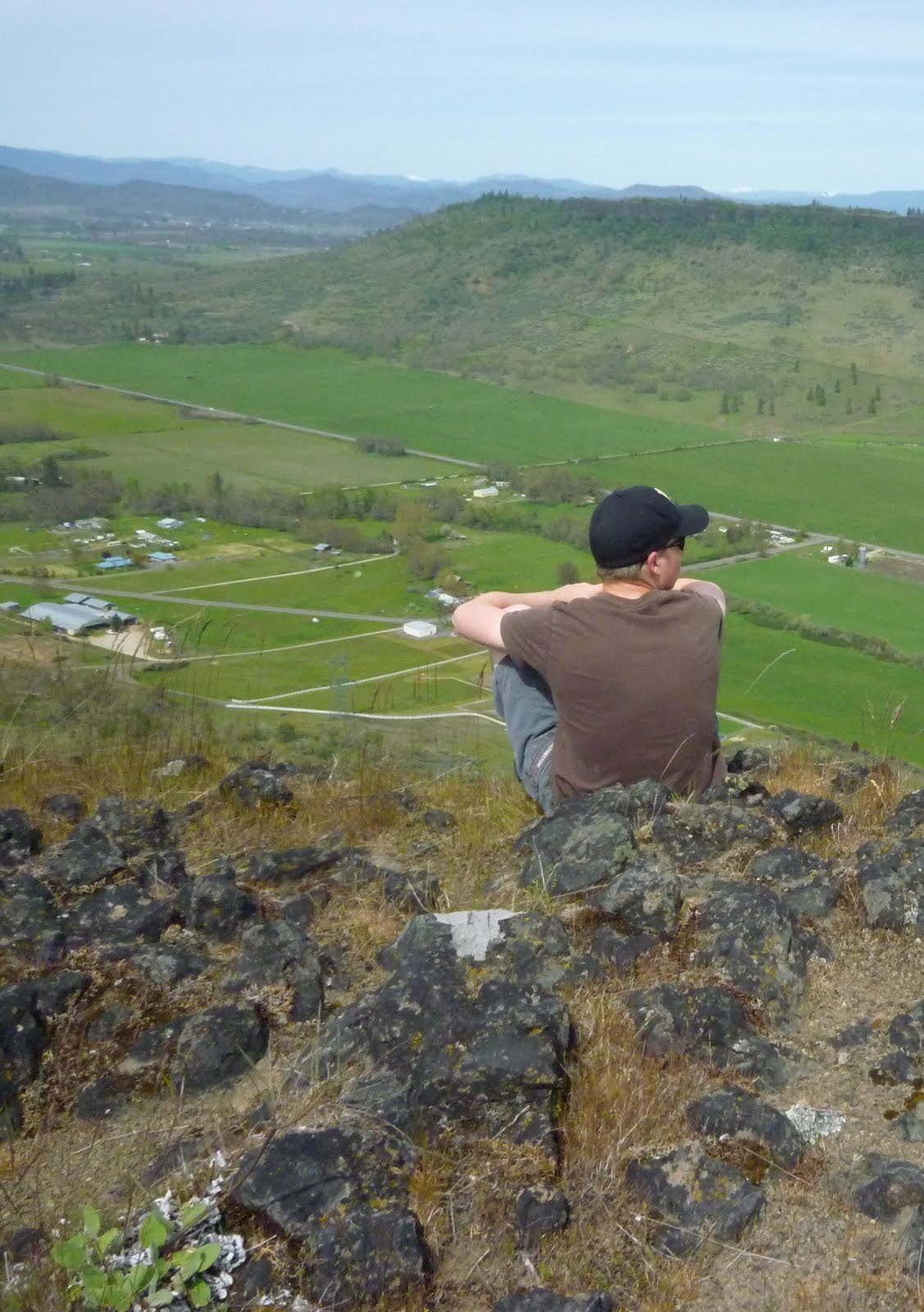
And when we got to the top, it was indeed a tableland of volcanic rock with sweeps of tiny yellow, purple and white flowers spreading out in every direction.


Mt. McLoughlin

The volcanic mountain commanding attention from that area, whether you are on the table or down below, is Mt. McLoughlin, one of the many such peaks making a line up and down the west side of our continent.


Oldest grandson enjoying the view
It makes me happy that our families like hiking together. When we visit one or another of our children they often want to show us a new trail or mountain discovery. Or we might decide to visit an old favorite place that requires a little trek to accomplish.

The day we left the Pathfinder Family, we stopped at a pioneer cemetery and strolled around looking at gravestones. I did say a prayer over some of them, but it wasn't until we got home a few days later that I realized I had missed the day that Orthodox go to cemeteries to bless the graves, the Tuesday after Bright Week. It was not the exact day I was graveside, but close. I love visiting the graves; there is always a touching epitaph to ponder, or a family group with dates that tell a vague but compelling story of love and loss.


The little town of Ashland, Oregon, was our next stop. It's known for its Shakespeare Festival, and special mineral water called Lithia Water. Lithia Park was lovely on this sunny day, and the mother duck was also out for a stroll with her children.

Pipe spouting Lithia Water
We stayed at Pippin's homestead for a couple of nights on our way back, and took a hike with those folks, too. It was pointed out that the peaks we stood on, one on Sunday with Pathfinder, and one on Tuesday with Pippin, both gave a view of Mount Ashland in Southern Oregon. But I didn't get a photo of that peak from either place.

The weather had started to warm up at long last, and by the time we got to the top of Yellow Butte the air was balmy. Before long I found myself lying on the short soft grass that has sprouted. I could have been happy to doze there for hours smelling the tiny flowers and shoots that were all around my head.

The view from my bed in the grass
Me
  
Scout eating cheese at the top


We ate a picnic of bread and cheese and strawberries, and Scout tottered around on the rocks while I tried to stay calm and remember that his balance is much better than mine.


Woolly-pod milk-vetch
Phlox was the most abundant flower on the top of that mountain, 
though there were a zillion lupine plants not blooming yet. 
And a pretty violet flower that no one knew the name of then (but I have since added above).

A ladybug came to our picnic.
Scout and his explorations and exclamations were the focus of this hike. His impatience at having to ride in the backpack up and down was softened occasionally when his mother or I handed him a new sort of twig or flower, or even one of the "spongy galls" that we found on the rabbit brush.

If we named the object, he would repeat whatever we said, usually many times, while trying to work it into his mind's growing encyclopedia. But he also got the fun of swinging up and down the slope by the arms of his parents, and that briefly pushed all the new words out of the way with giggles.